Soundbar placement: where it goes and how far from the TV
One speaker, a few placement rules, and model-specific gaps that matter more than most people think.
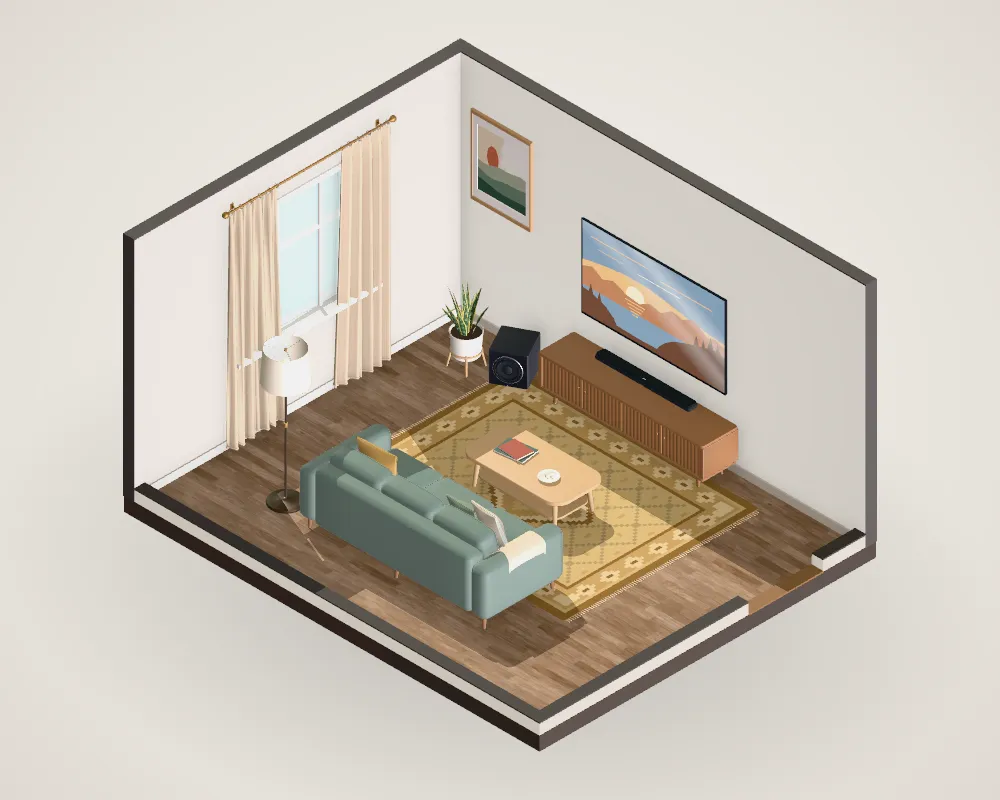
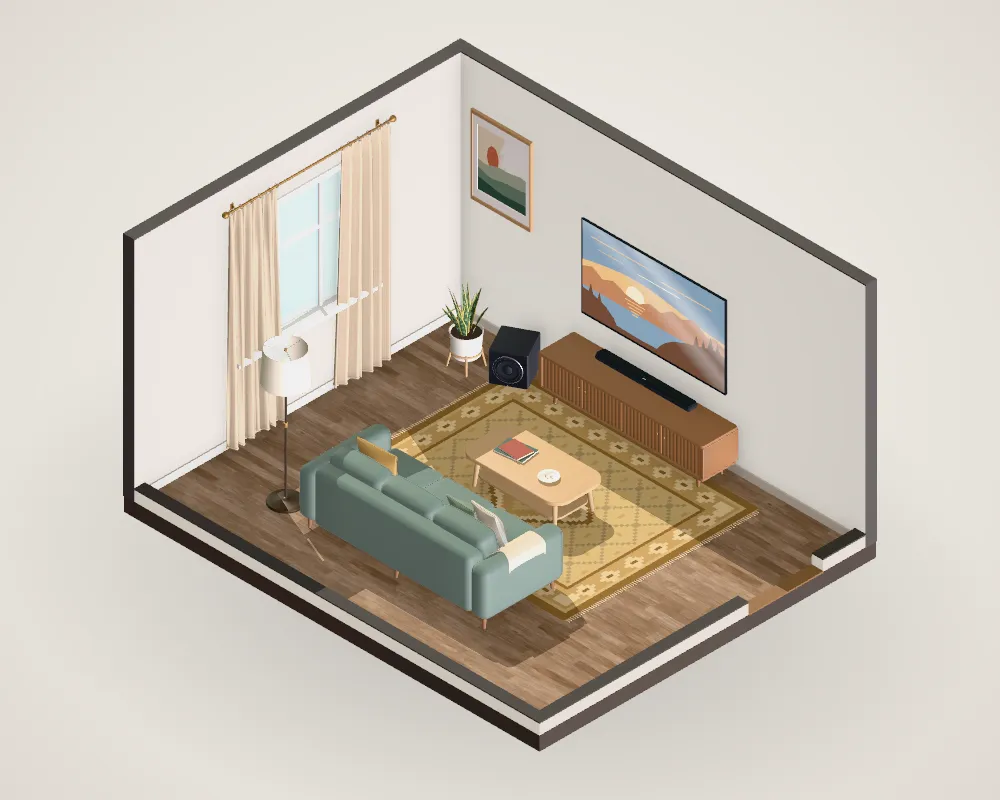
Put the soundbar directly below the TV, centered, level and facing the seats (THX says below, not above, and not tilted). On a console, bring its front to the shelf edge and keep it out of enclosed cabinets. Leave the gap your model specifies between the bar and the TV: for example at least 4 inches for a Sonos Arc Ultra or a wall-mounted Bose Lifestyle Ultra, 2 inches for a Sonos Beam, and 2 inches below a wall-mounted TV for Samsung’s HW-Q990 models. Make sure it doesn’t block the TV’s remote sensor.
The basic rule
THX’s advice is short: put the bar immediately below the TV, not above it, and don’t tilt it. Centered under the screen, the sound comes from close to the picture, and facing straight out it reaches every seat evenly.
How big a gap to leave
Every maker publishes its own gap, and they differ more than you’d expect:
| Soundbar | Gap to the TV |
|---|---|
| Sonos Arc Ultra | At least 4 in between the top of the bar and the bottom of the TV; on the wall, ends at least 1 ft from walls |
| Sonos Beam (Gen 2) | At least 2 in from the TV; don’t block the TV’s IR sensor |
| Bose Lifestyle Ultra | Wall-mounted: top of the bar at least 4 in below the TV; on a shelf, front flush with the edge and back at least 0.4 in clear |
| Samsung HW-Q990D / Q990F | Wall-mounted: at least 2 in (5 cm) below the TV; on a stand: at least 2 cm from the TV for the microphone |
| Sony BRAVIA Theatre Bar 9 / 8 | Wall-mounted under a wall-mounted TV: at least 120 mm (4.7 in) if the mounted TV is less than 85 mm deep, 200 mm (7.9 in) if it’s deeper, so the up-firing sound isn’t blocked |
Two reasons for the gaps: up-firing Atmos drivers need clear air above them, and the bar mustn’t cover the bottom of the picture or the TV’s remote-control sensor.
On a console or shelf
- Bring the bar to the front edge. Set back on a deep shelf, the bar’s sound reflects off the shelf top and loses clarity. Bose asks for the front of the bar to be flush with the shelf edge.
- Never inside a cabinet. Sonos, Bose and others all say no enclosed cabinets and no corners. Side-firing and up-firing drivers need open space.
- Check the IR sensor. On TVs sitting on short feet, a tall bar can cover the remote sensor. Sony’s support advice is to move the bar; use the bar’s IR repeater only if the TV stops responding, because enabling it unnecessarily can cause interference.
On the wall
When the TV is wall-mounted, mounting the bar on the wall below it keeps them aligned and frees the console. Use the bar’s own bracket and its specified gap. With the TV’s center at the usual 42 inches, a 65-inch TV’s bottom edge sits about 26 inches up, which leaves plenty of room for a bar and its gap below.
Rear speakers and subwoofers for soundbars
Many soundbars add wireless surrounds and a sub. Sonos suggests surrounds behind and to either side of the usual seat, about 10 feet from it and angled toward the seating; Samsung’s manuals show rear speakers at 135–150°. Bose puts its surrounds at ear height or higher at the back of the room. For the sub, the subwoofer crawl works the same with a soundbar as with any system.
Check the gap in 3DRoom Studio flags a soundbar that rises into the picture and shows the angle to each seat. Open Room Studio →Questions people ask
How far below the TV should a soundbar be?
It depends on the model. Sonos asks for at least 4 inches below an Arc Ultra and 2 inches for a Beam; Bose asks for 4 inches below a wall-mounted Lifestyle Ultra; Samsung asks for 2 inches (5 cm) below a wall-mounted HW-Q990. Sony’s Theatre Bar 9 and 8 need about 4.7 inches (120 mm) under a slim wall-mounted TV and about 7.9 inches (200 mm) under a deeper one.
Can a soundbar go above the TV?
Some can: Sonos allows it for the Arc Ultra and Bose for some models. THX recommends below, because the sound then comes from close to the picture’s lower edge, where most dialogue sits. Follow your model’s manual.
Should a soundbar be in a cabinet?
No. Sonos, Bose and others say not to put a soundbar inside an enclosed cabinet or in a corner: the cabinet blocks the side- and up-firing drivers and colors the sound. If it sits on a shelf, bring it to the front edge.
Should a soundbar be wall-mounted or on a stand?
Either works if you follow the gap rules. Wall-mount it when the TV is on the wall, so both line up; keep it on the console when the TV stands there. We found no controlled measurements showing one is better acoustically.
Sources
- THX. Where should I place my speaker bar?.Professional guide
- Sonos. Sonos Arc Ultra user guide (placement).Manufacturer
- Sonos. Sonos Beam (Gen 2) user guide (select a location).Manufacturer
- Bose (2026). Soundbar placement: Lifestyle Ultra Soundbar.Manufacturer
- Samsung (2025). HW-Q990F / Q930F / Q800F user manual.Manufacturer
- Samsung (2024). HW-Q990D user manual.Manufacturer
- Sony Electronics (2025). BRAVIA Theatre Bar 9/8 help guide (installation).Manufacturer
- Sony Electronics Support (2021). The sound bar is blocking the IR sensor of the TV.Manufacturer
- Dolby Laboratories (2018). Dolby Atmos Home Theater Installation Guidelines, r3.1.Manufacturer
Numbers on this page follow these sources. Where a figure is our own calculation or a rule of thumb, the text says so. Found a mistake? Tell us.