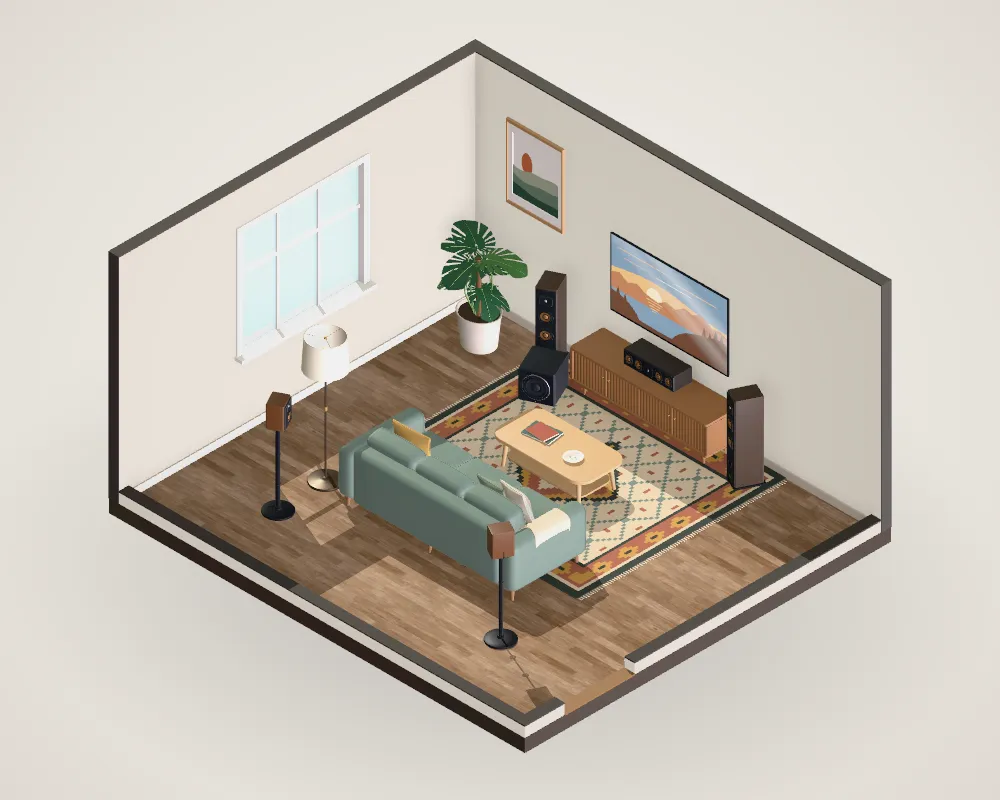
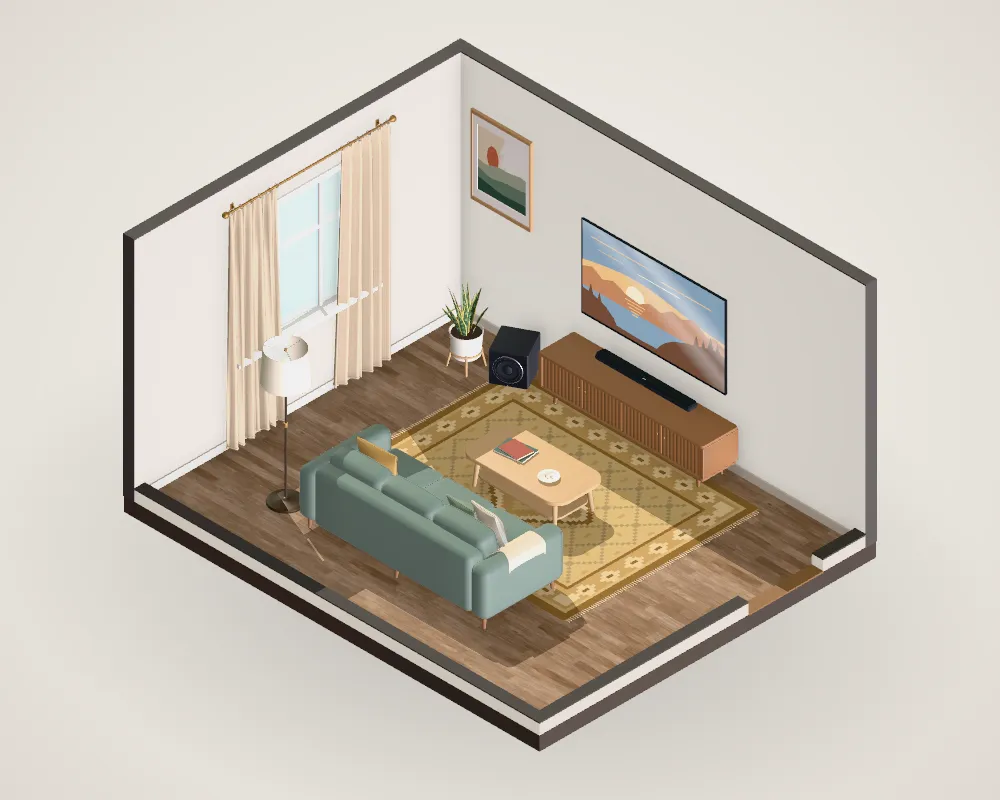
Dolby Atmos speaker placement (5.1.2, 5.1.4 and 7.1.4)
The number after the second dot is the overhead speakers. Here's where they go, in the ceiling or bounced off it.
Dolby Atmos adds height speakers to a normal 5.1 or 7.1 layout. With two overheads (5.1.2), put them in the ceiling slightly in front of your seat, about 80° up (65–100°), roughly in line with the front left and right. With four (5.1.4, 7.1.4), put one pair about 45° up in front of you and one about 45° up behind (30–55° each). Up-firing speakers sit on top of (or within 3 ft of) the front speakers, bounce sound off the ceiling, and need a flat, reflective ceiling 7.5–14 ft high, with listeners at least 3 ft away.
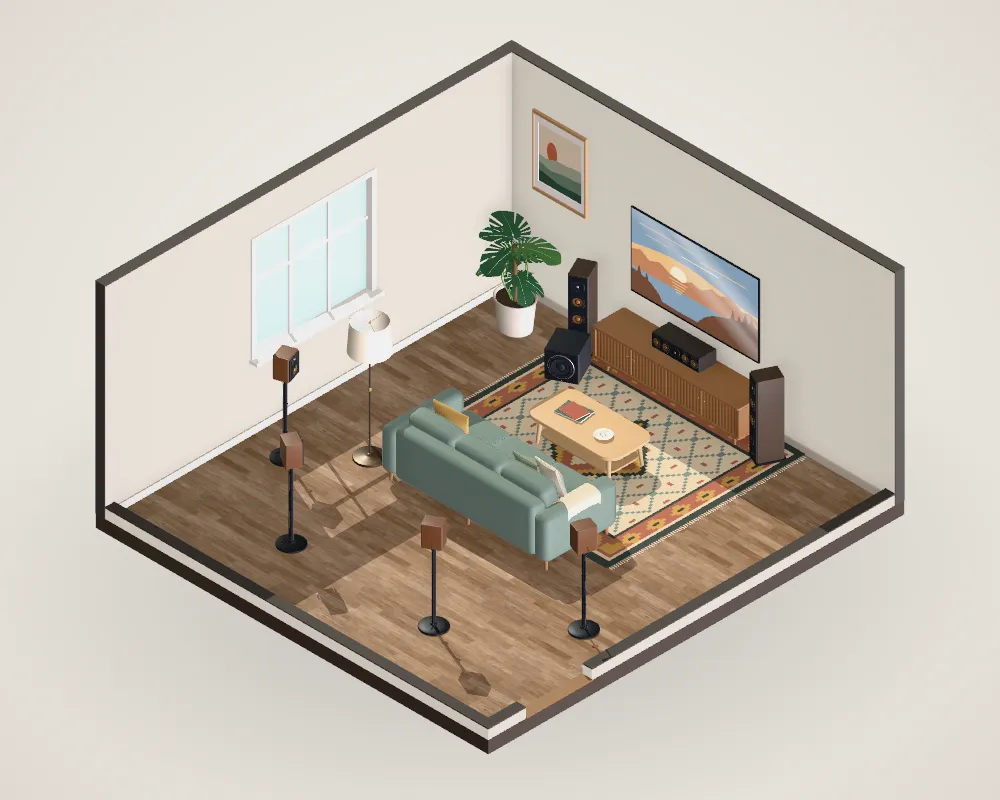
What the numbers mean
Atmos layouts are written as three numbers: ear-level speakers . subwoofers . height speakers. A 5.1.2 system is a normal 5.1 plus two height speakers; 7.1.4 is 7.1 plus four. The ear-level part is placed exactly as in 5.1 or 7.1. The heights add sound from above: rain, flyovers, the room around a scene.
In-ceiling height speakers
Dolby specifies height speakers by their elevation angle: how far above your ears they sit, measured from straight ahead.
| Layout | Height speakers | Elevation | Left–right spacing |
|---|---|---|---|
| 5.1.2 / 7.1.2 | Top middle | About 80° (65–100°): nearly overhead, slightly in front | Roughly in line with the front left and right |
| 5.1.4 / 7.1.4 | Top front | About 45° (30–55°) in front of you | In line with the front left and right |
| 5.1.4 / 7.1.4 | Top rear | About 45° (30–55°) behind you | In line with the front left and right |
To turn an angle into a ceiling position: take the height of the ceiling above your ears (ceiling height minus about 3.9 ft). At 45°, the speaker sits that same distance in front of or behind your head. In a room with an 8.5-ft ceiling that’s about 4.6 ft forward and 4.6 ft back. Dolby’s guidelines also note that height speakers work best mounted at two to three times the height of the ear-level speakers.
Speaker placement plannerPick 5.1.2 or 7.1.4 to see the overhead positions for your room. Open →Up-firing (Atmos-enabled) speakers
If you can’t put speakers in the ceiling, up-firing modules and soundbars bounce sound off it instead. Dolby’s rules for them:
- On top of the front left and right speakers (and ideally the rear or side surrounds for a second pair), or within about 3 ft (0.9 m) of them.
- At or slightly above ear height, no higher than half the wall height.
- At least 3 ft (0.9 m) from listeners, ideally 5 ft (1.5 m), so you hear the reflection rather than the speaker.
- A flat, acoustically reflective ceiling 7.5 to 14 ft (2.3–4.3 m) high, ideally under 12 ft. Angled, vaulted or acoustic-tile ceilings scatter or absorb the reflection.
The same ceiling rules apply to Atmos soundbars. Sonos and Bose both say not to put an Atmos bar inside a cabinet or under a shelf, where the up-firing drivers are blocked.
Which Atmos layout for your room?
- Living room, sofa against the back wall: 5.1.2. Two top-middle speakers slightly in front of the sofa add height without needing space behind you.
- Living room with space behind the seats: 5.1.4 or 7.1.4, if the ceiling allows four speakers.
- Rented home, can’t cut the ceiling: an Atmos soundbar or up-firing modules on the front speakers, if the ceiling is flat and hard.
- Dedicated theater: 7.1.4 or more, in-ceiling.
Whatever the layout, keep left–right pairs symmetrical, aim speakers at the main seat where the mounting allows, and run room calibration afterwards.
Questions people ask
What does 5.1.2 mean?
Five ear-level speakers (left, center, right and two surrounds), one subwoofer, and two height speakers. 7.1.4 is seven ear-level speakers, one subwoofer and four height speakers.
Where should Atmos ceiling speakers go for 5.1.2?
Slightly in front of the main seat, at about 80° elevation (Dolby allows 65–100°), spaced roughly in line with the front left and right speakers.
Do up-firing Atmos speakers work?
They can, in the right room. They need a flat, hard ceiling between about 7.5 and 14 feet high (ideally under 12), and should sit on or near the front speakers, at least 3 feet (ideally 5) from listeners. Vaulted, angled or acoustic-tile ceilings defeat them.
Is 5.1.2 better than 7.1?
In many living rooms, yes. If there’s little space behind the seating, two height speakers add more than two rear speakers, and they fit in rooms where rears would sit right behind your head.
Sources
- Dolby Laboratories (2018). Dolby Atmos Home Theater Installation Guidelines, r3.1.Manufacturer
- CEDIA / CTA (2023). CEDIA/CTA-RP22 Immersive Audio Design Recommended Practice, v1.2.Standard
- Sonos. Sonos Arc Ultra user guide (placement).Manufacturer
- Bose (2026). Soundbar placement: Lifestyle Ultra Soundbar.Manufacturer
- Samsung (2025). HW-Q990F / Q930F / Q800F user manual.Manufacturer
Numbers on this page follow these sources. Where a figure is our own calculation or a rule of thumb, the text says so. Found a mistake? Tell us.