How it works
For a rectangular room with hard walls, the mode frequencies follow one formula: f = (c ÷ 2) × √((nx ÷ L)² + (ny ÷ W)² + (nz ÷ H)²), with c the speed of sound (343 m/s) and n whole numbers. Modes with one non-zero number run along one dimension (axial), two (tangential) or all three (oblique).
Axial modes are usually the strongest, which is why the chart draws them tallest. The often-quoted −3 dB for tangential and −6 dB for oblique modes is a textbook convention (Everest and Pohlmann) rather than a law: wall construction and the source and listener positions change the real levels.
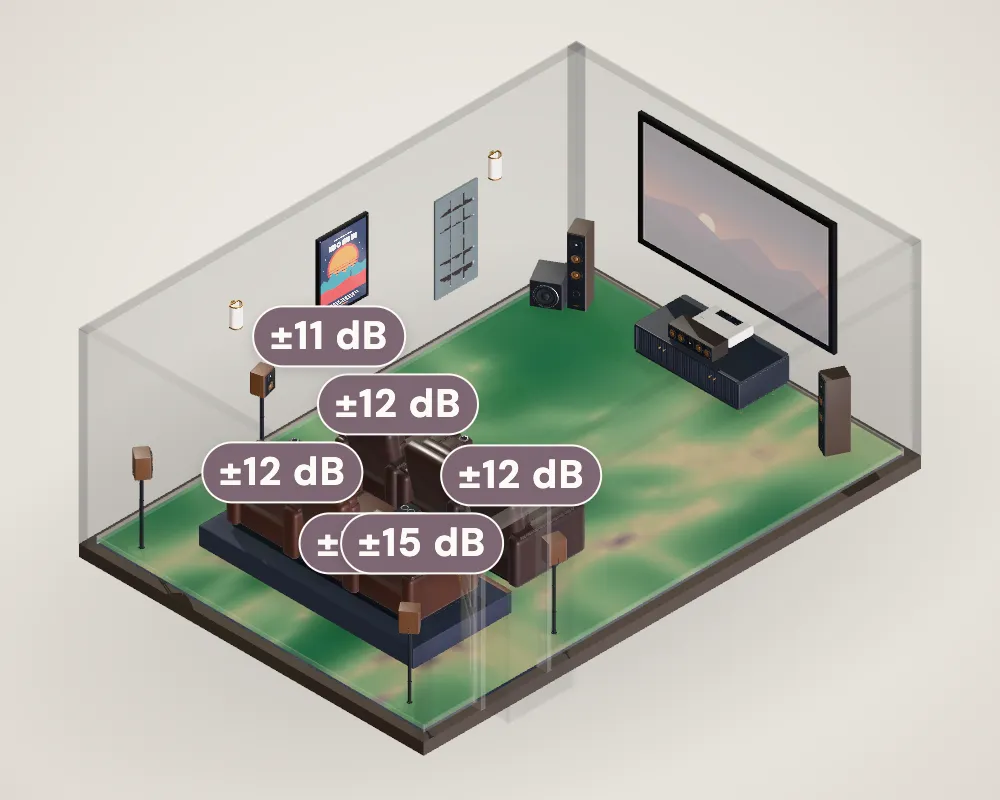
This calculator lists frequencies. It doesn’t predict how loud each one will be at your seat; for that, use the subwoofer placement simulator, which adds up every mode for a given sub and seat.
Questions people ask
What are room modes?
Standing waves between a room’s surfaces at frequencies where whole numbers of half-wavelengths fit between them. At those frequencies bass builds up near the walls and cancels at points in between, so some notes boom and others vanish depending on where you sit.
What is the Schroeder frequency?
A rough estimate of where individual modes stop dominating because they overlap: 2000 × √(decay time ÷ volume). In a typical living room it falls somewhere around 100–200 Hz. It is a transition, not a sharp boundary.
Can I fix room modes?
Partly. Moving the seat and the subwoofer changes which modes you hear most; two or more subs even out the response across seats; thick bass traps and room EQ reduce the worst peaks. Deep dips can’t be fixed with EQ, only by moving things.
Sources
- Room EQ Wizard. Room Simulation (modal simulator) help.Professional guide
- Routledge (2018). Sound Reproduction: The Acoustics and Psychoacoustics of Loudspeakers and Rooms, 3rd ed. (Floyd Toole; ISBN 9781138921368).Research
- Journal of the Acoustical Society of America (1979). Image method for efficiently simulating small-room acoustics (Allen & Berkley).Research
- CEDIA / CTA (2023). CEDIA/CTA-RP22 Immersive Audio Design Recommended Practice, v1.2.Standard
Numbers on this page follow these sources. Where a figure is our own calculation or a rule of thumb, the text says so. Found a mistake? Tell us.