How it works
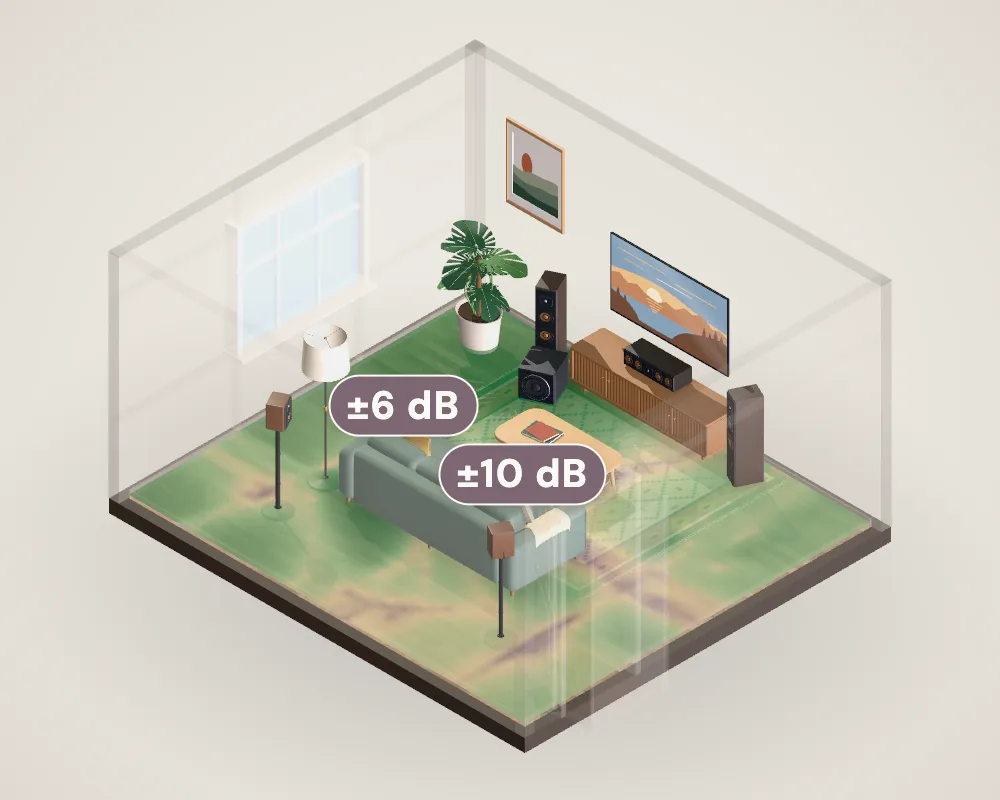
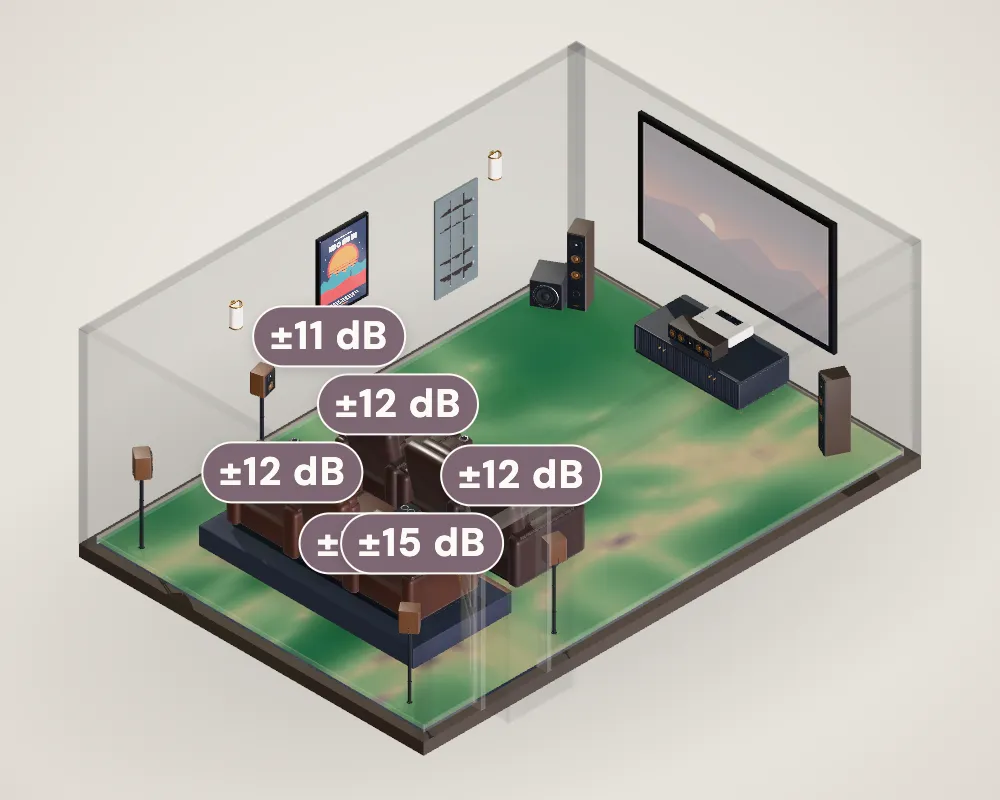
Below about 200 Hz, a room behaves like a set of resonances, or room modes. Each mode has a frequency set by the room’s dimensions and a pressure pattern that is high at the walls and has dead spots in between. The bass you hear is the sum of all of them, weighted by how strongly the sub excites each mode and how strongly your head sits in it.
The simulator uses the standard modal model of a rectangular room from acoustics textbooks (Kuttruff’s Room Acoustics): for each possible sub position on the floor it adds up every mode below 320 Hz at your seat, at ear height, with damping set by the room’s low-frequency decay time. It then measures how uneven the result is from 25 to 120 Hz. Because sound travels the same way in both directions, that’s the same thing the real subwoofer crawl measures.
The “two subs” option mirrors a second sub on the opposite side of the room. Harman’s Welti and Devantier found two well-placed subs nearly as effective as four at evening out bass across seats; opposite wall midpoints are a strong starting point.
Questions people ask
How accurate is a subwoofer placement simulator?
It captures the biggest effect, the room’s standing waves, for a rectangular room with uniform damping. It ignores furniture, doors, openings and wall construction, which can shift peaks and dips by a few hertz. Use it to choose candidate spots, then confirm by ear or with a measurement microphone.
Why does the best spot change when I move my seat?
Because bass at your seat depends on both positions: which room modes the sub excites and which ones your head sits in. That’s also why moving the sofa a foot or two can fix bass as well as moving the sub.
What does the dB figure mean?
It is the standard deviation of the bass level at your seat across 25 to 120 Hz: how far individual notes stray from the average. Around 3–5 dB is smooth for a real room; 8 dB or more means some notes boom while others almost vanish.
Sources
- SVS. The Art of Subwoofer Placement.Manufacturer
- KEF (2025). Phase and positioning: where to place a subwoofer.Manufacturer
- Journal of the Audio Engineering Society / Harman (2006). Low-Frequency Optimization Using Multiple Subwoofers (Welti & Devantier).Research
- CEDIA / CTA (2023). CEDIA/CTA-RP22 Immersive Audio Design Recommended Practice, v1.2.Standard
- Room EQ Wizard. Room Simulation (modal simulator) help.Professional guide
- Journal of the Acoustical Society of America (1979). Image method for efficiently simulating small-room acoustics (Allen & Berkley).Research
- Journal of the Audio Engineering Society / Harman (2006). Loudspeakers and Rooms for Sound Reproduction — A Scientific Review (Toole).Research
- Genelec. How to place your monitors.Manufacturer
Numbers on this page follow these sources. Where a figure is our own calculation or a rule of thumb, the text says so. Found a mistake? Tell us.