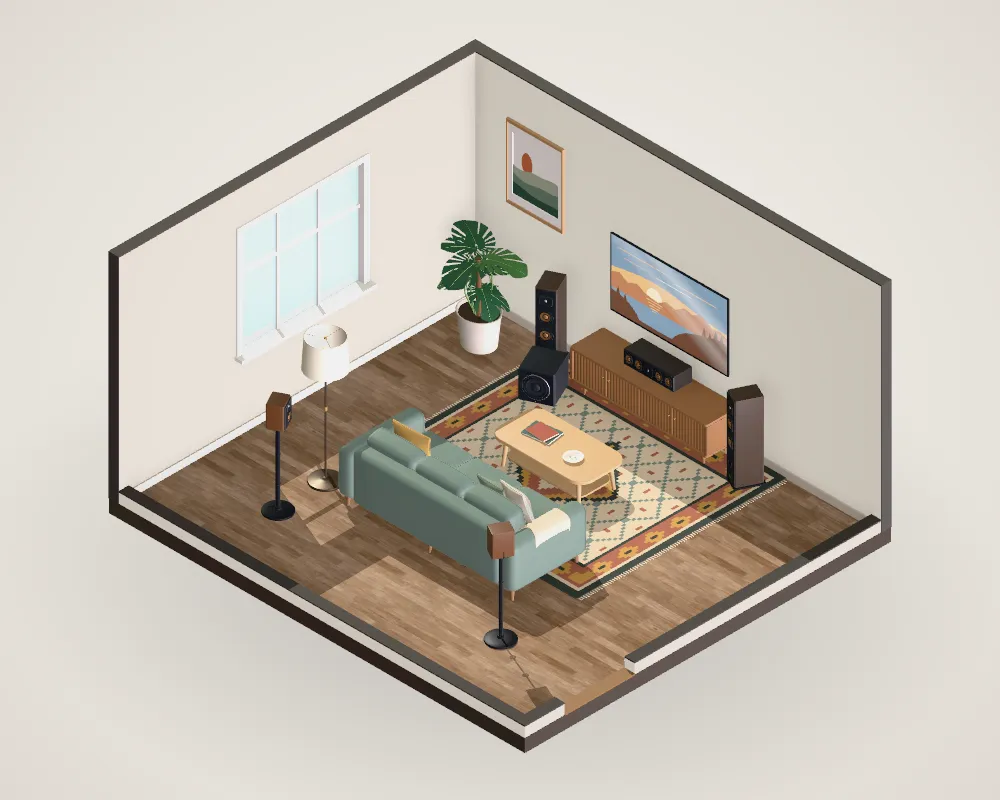
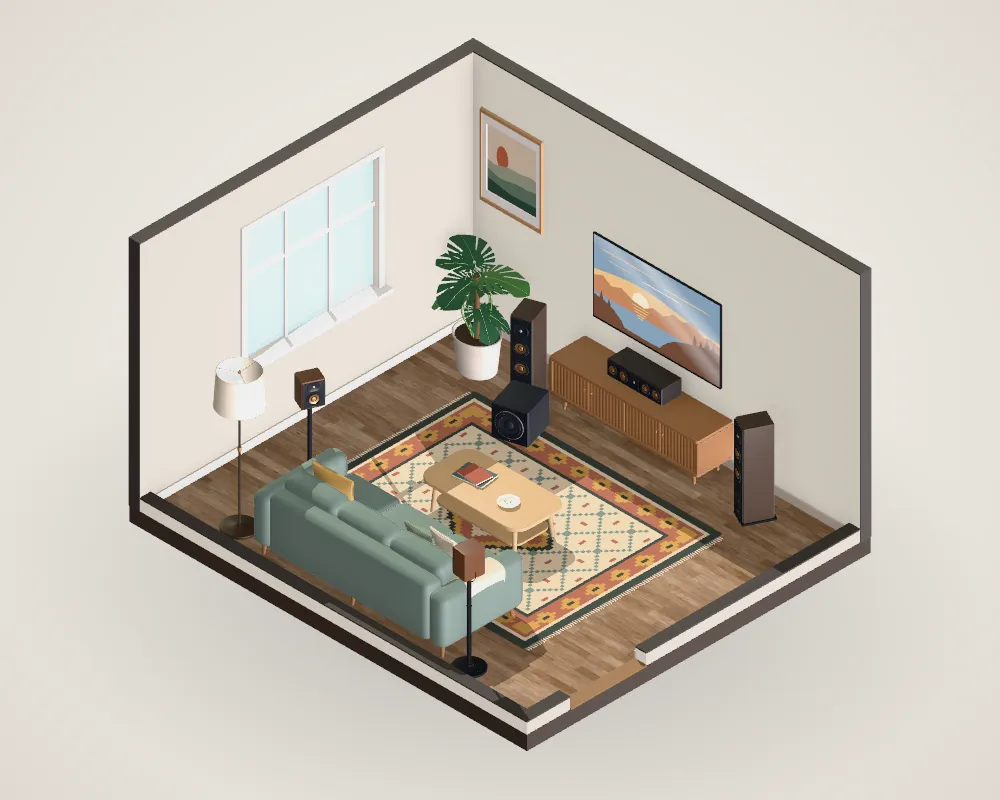
7.1 speaker placement
Two more speakers behind you. They're worth it in the right room, and counterproductive in the wrong one.
7.1 keeps the 5.1 front speakers (left and right at 22–30°, center at the screen) and splits the surrounds into side surrounds at 90–110°, beside you, and rear surrounds at 135–150°, behind you (Dolby). All four go at about ear height, 1.2 m. 7.1 only works with space behind the seating: if your sofa is against the back wall, CEDIA/CTA RP22 recommends dropping the rears and using 5.1.
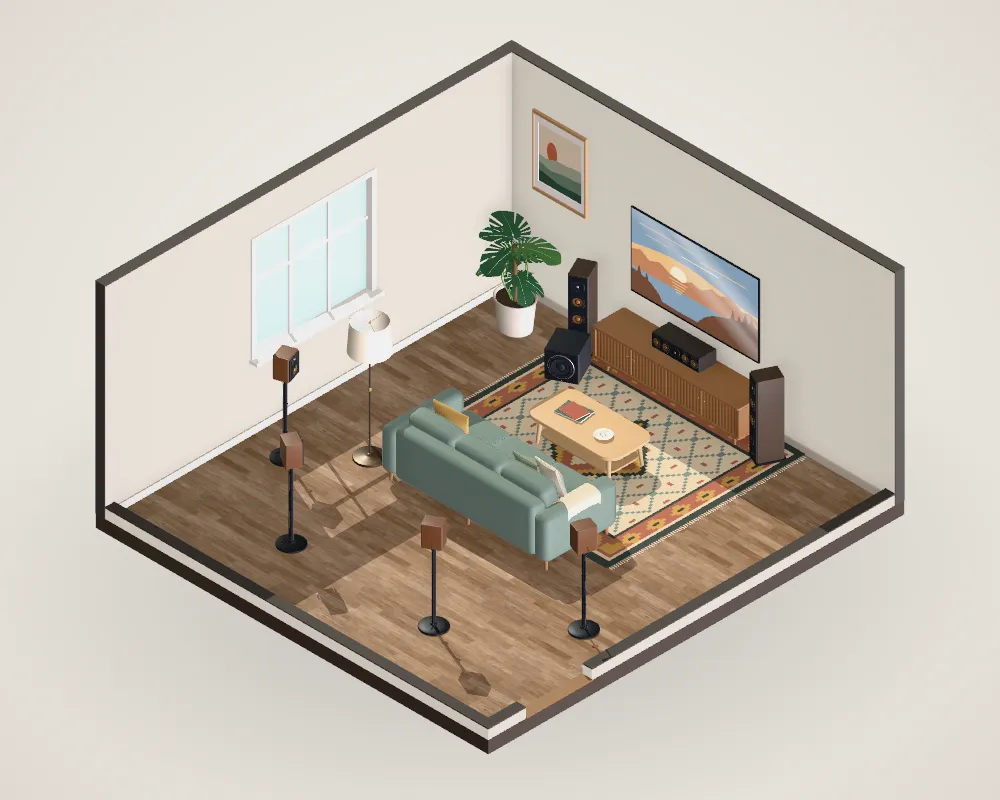
The 7.1 layout
| Speaker | Angle from straight ahead | Height |
|---|---|---|
| Front left / right | 22–30° | Ear level |
| Center | 0°, at the screen | Just above or below the screen |
| Side surround left / right | 90–110° | Ear level |
| Rear surround left / right | 135–150° | Ear level |
| Subwoofer | Placed for even bass | Floor |
These are the ranges in Dolby’s home-theater installation guidelines; SVS gives the same, and Samsung’s HW-Q990 soundbar manuals show rear speakers at 135–150°. Ear height is 1.2 m (3.9 ft).
Plan your 7.1 layoutPositions and distances for your room and seat. Open →What the extra pair does
In 5.1, the two surrounds have to cover both the sides and the back. In 7.1, the side surrounds take the sides and the rears fill in behind, so sounds panning from front to back move smoothly instead of jumping. The difference is most obvious in rooms with more than one row, and in films mixed for 7.1.
When 7.1 is worth it
- There’s space behind the seats. Rear surrounds need to be behind you, at a similar distance to the other speakers. A few feet between the back of the sofa and the back wall is the minimum that makes them work.
- You have more than one row. Side surrounds cover the front row and rears cover the back.
- The room is long rather than wide. Rear surrounds fill the back of a deep room.
When 5.1 (or 5.1.2) is better
If the sofa is against the back wall, rear speakers end up a foot or two behind your head: much too close and too loud. CEDIA/CTA RP22 says to use side surrounds only when the seating is against the back wall. In that room, spend the money on overhead speakers instead: 5.1.2 adds height effects that are easy to fit in a living room. See Dolby Atmos speaker placement.
Getting the heights right
All four surrounds should be at about ear height. Dolby allows the rears a little higher, up to 1.25 times the height of the front speakers, and CEDIA/CTA RP22 allows raising surrounds about a foot in multi-row rooms so they aren’t blocked by heads. Keep left and right pairs at the same height, and aim every speaker at the main seat.
After placing them, run your receiver’s room calibration so distances and levels are matched from your seat.
Questions people ask
Is 7.1 better than 5.1?
In a room with space behind the seats, 7.1 makes sound moving from front to back smoother and fills the gap behind you. In a living room where the sofa is against the back wall, the rear speakers end up next to your ears, and 5.1 sounds better. Adding overhead speakers (5.1.2) often gives more for the money than rears.
Where do the rear speakers go in 7.1?
Behind you, at 135–150° from straight ahead (Dolby), at about ear height and aimed at the seating. Samsung shows the same 135–150° range for its soundbar rear speakers.
Can I use 7.1 with the couch against the wall?
It isn’t recommended. With no space behind you, the rear surrounds are too close and too loud. CEDIA/CTA RP22 advises side surrounds only (5.1) when seating is against the back wall.
Sources
- Dolby Laboratories (2018). Dolby Atmos Home Theater Installation Guidelines, r3.1.Manufacturer
- ITU-R (2012). Recommendation ITU-R BS.775-3: Multichannel stereophonic sound system with and without accompanying picture.Standard
- CEDIA / CTA (2023). CEDIA/CTA-RP22 Immersive Audio Design Recommended Practice, v1.2.Standard
- SVS. Speaker Placement Guide for Home Audio.Manufacturer
- Samsung (2025). HW-Q990F / Q930F / Q800F user manual.Manufacturer
- Samsung (2024). HW-Q990D user manual.Manufacturer
Numbers on this page follow these sources. Where a figure is our own calculation or a rule of thumb, the text says so. Found a mistake? Tell us.