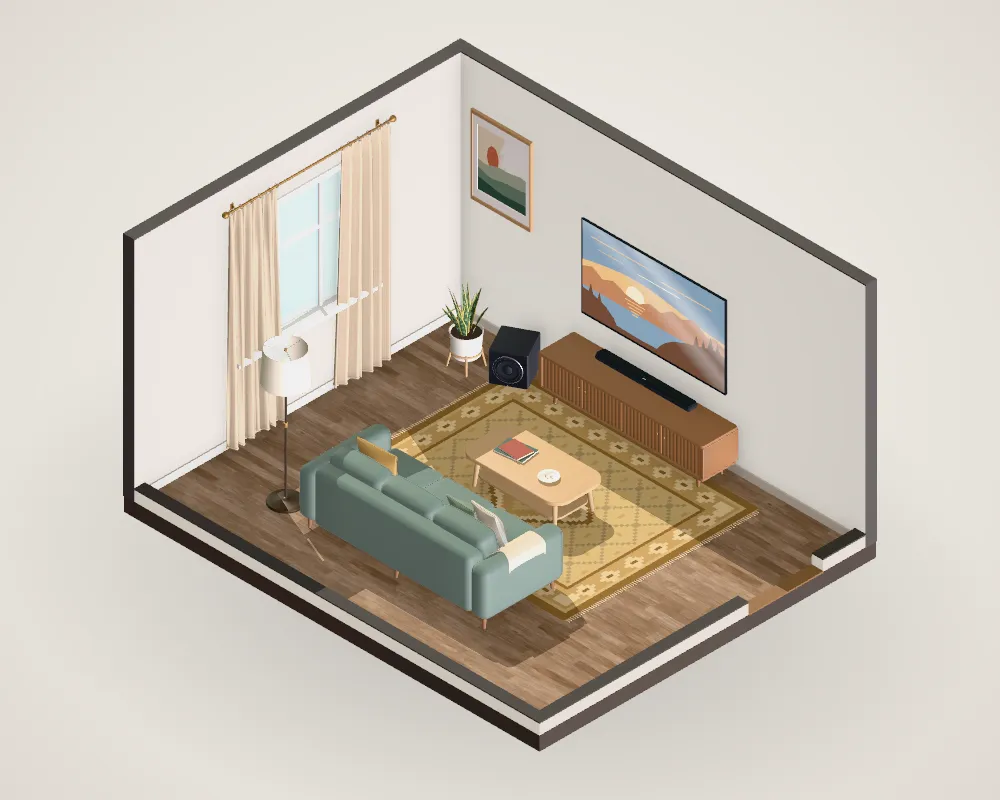
Center speaker above or below the TV?
It carries most of the dialogue, so it gets its own placement rules.
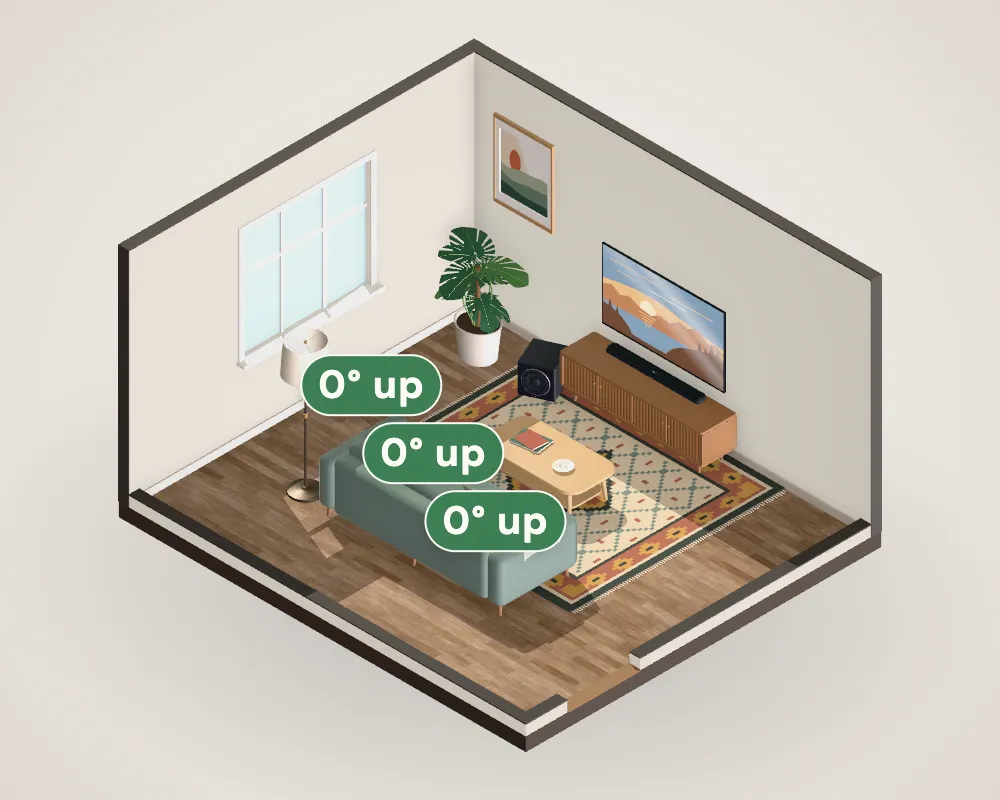
Either above or below works; what matters is that the center speaker sits as close to the edge of the screen as possible, on the center line, and is aimed at your ears: tilted up if it’s below the screen, down if it’s above (SVS, Klipsch). On a console, pull it forward so its front is flush with the shelf edge, or the shelf reflects sound up into it and muddies dialogue. Below the TV is usually easier; above suits TVs that sit low.
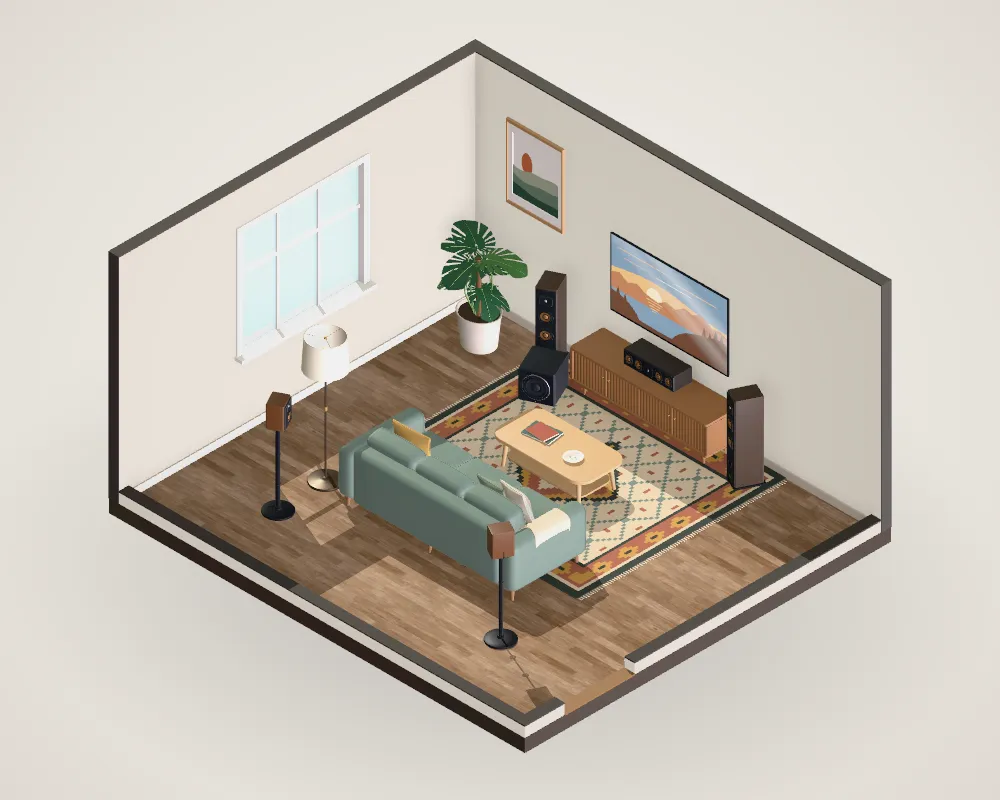
Why the center speaker is special
In a surround system, the center channel carries most of the dialogue. If it sits far from the picture, voices seem to come from below or above the actors; if it fires at your chest or over your head, dialogue loses clarity. Getting it close to the screen and aimed at your ears does more for intelligibility than almost anything else.
The rules
- On the screen’s center line. Straight ahead of the main seat.
- As close to the screen’s top or bottom edge as you can. CEDIA/CTA RP22 asks for it as close as possible to the top or bottom of the screen, away from surfaces that would reflect strongly; ITU’s layout puts it immediately above or below the picture when it can’t sit behind it.
- Aimed at your ears. SVS says to tilt it up when it’s below the screen and down when it’s above. The tilt angle is the arctangent of the height difference between the tweeter and your ears over the distance to your seat; no maker publishes a fixed number.
- Flush with the shelf edge. Klipsch’s advice: bring the front of the speaker to the front edge of the shelf or console. Set back, the shelf top reflects sound into the speaker’s path and smears dialogue.
Below the TV
The usual position. The center sits on the console, angled up a few degrees on a wedge or stand, with its front at the console edge. Check that it doesn’t rise into the picture: on TVs with short feet, a tall center speaker can cover the bottom of the screen, just like a soundbar. Room Studio flags it when it does.
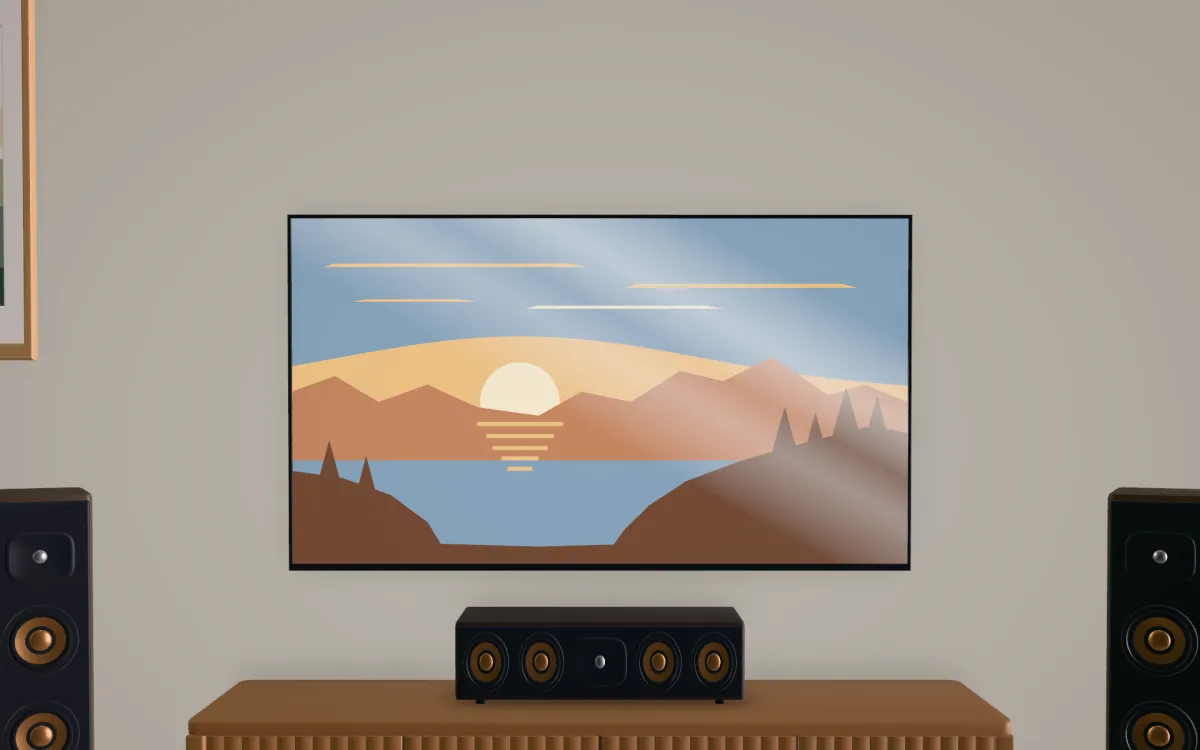
Above the TV
Works well when the TV sits low on a console, or when the console is too shallow for a speaker. Mount it on a shelf or bracket just above the screen, tilted down toward the seats. Above a wall-mounted TV, keep it as close to the top edge as the mount allows.
Matching the fronts
Dolby and ITU place the front left and right at ear height. With the center slightly lower or higher, keep it aimed at your ears and let the receiver’s calibration match its level to the others. If the center is far below the front speakers, raising the fronts’ tweeters closer to the center’s height helps voices pan smoothly across the screen.
Speaker placement plannerPositions for the center and every other speaker in your room. Open →Questions people ask
Is it better to put a center speaker above or below the TV?
Neither is better in general. Below is more common and easier to set up; above works well when the TV sits low or the console has no room. In both cases keep it close to the screen and tilt it toward your ears.
How much should I tilt my center speaker?
Enough that its tweeter points at your ears. Manufacturers don’t publish a fixed angle; you can work it out as the arctangent of the height difference between the tweeter and your ears divided by your seating distance. Small wedges or angled stands do the job.
Can the center speaker go inside a TV cabinet?
Only if its front is flush with the cabinet’s front edge. Set back inside a shelf, the surrounding surfaces reflect and color the sound.
Sources
- SVS. Center Channel Speaker Placement Tips.Manufacturer
- Klipsch (2021). How to set up Klipsch speakers.Manufacturer
- CEDIA / CTA (2023). CEDIA/CTA-RP22 Immersive Audio Design Recommended Practice, v1.2.Standard
- ITU-R (2012). Recommendation ITU-R BS.775-3: Multichannel stereophonic sound system with and without accompanying picture.Standard
- Dolby Laboratories (2018). Dolby Atmos Home Theater Installation Guidelines, r3.1.Manufacturer
Numbers on this page follow these sources. Where a figure is our own calculation or a rule of thumb, the text says so. Found a mistake? Tell us.