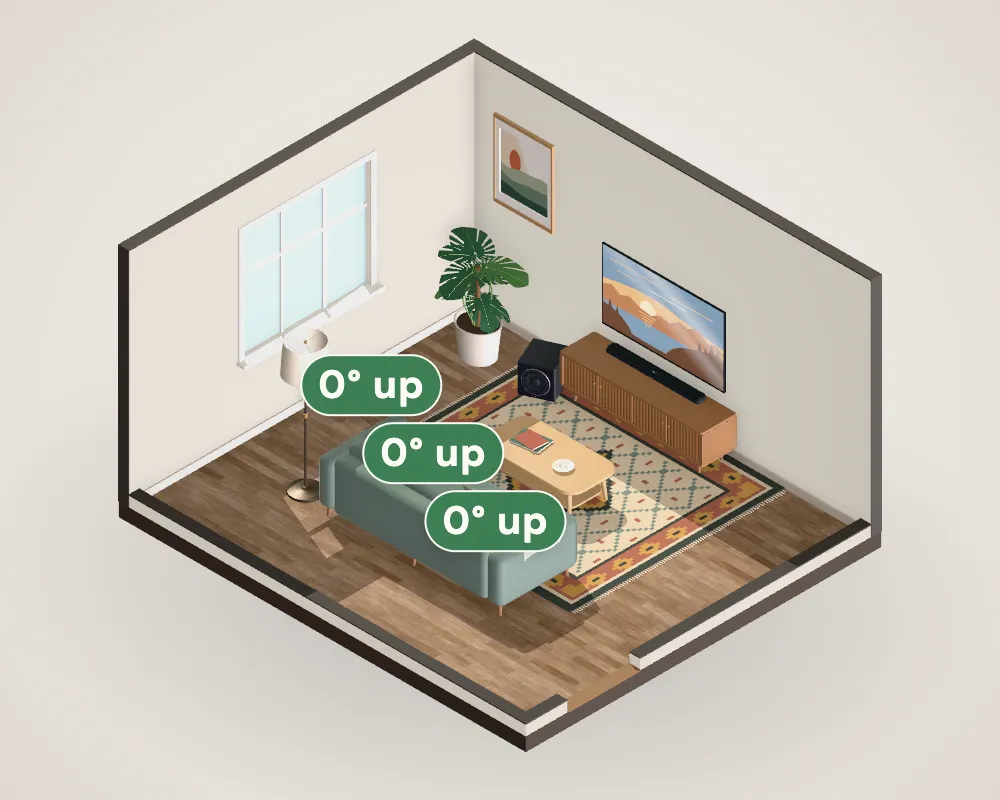
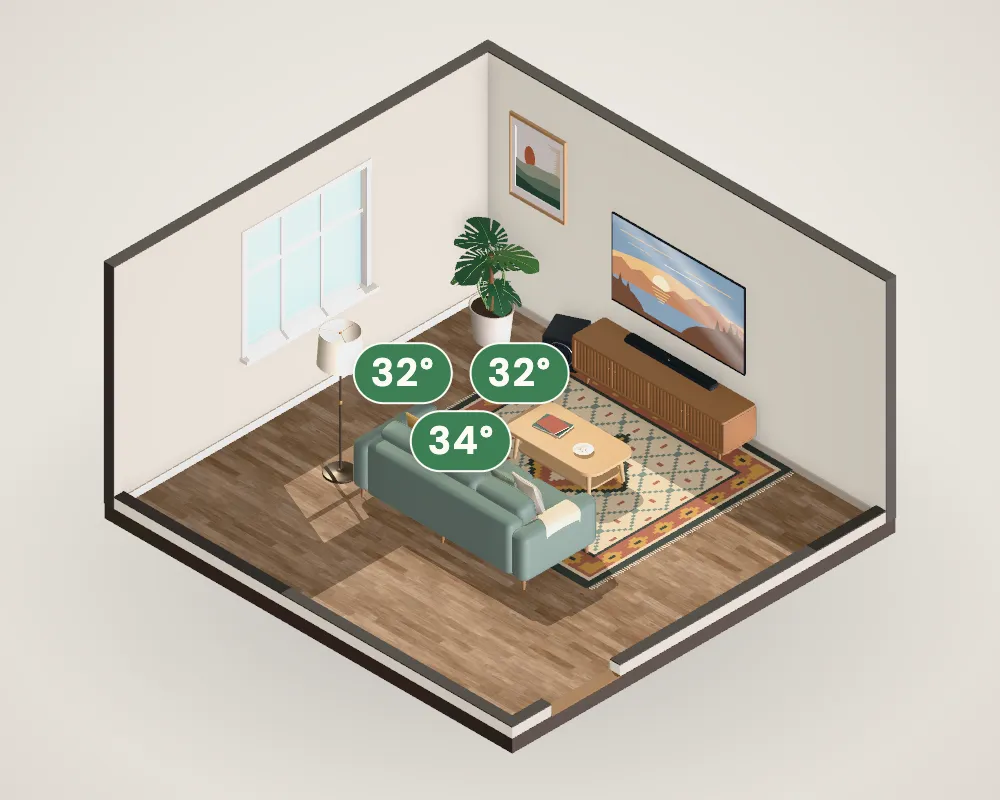
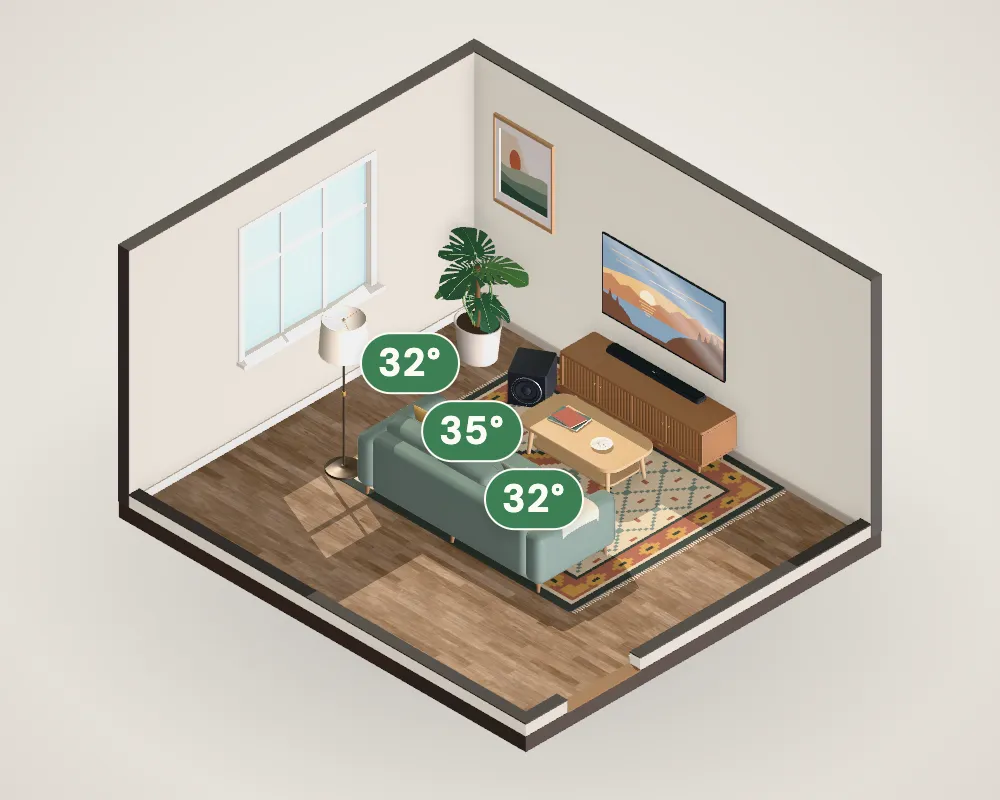
TV above a fireplace: how high is too high?
Two problems, not one: how far up you'll be looking, and how hot the TV will get. Both can be measured before you drill.
Over a 54-inch mantel, a 65-inch TV’s center sits near 74 inches: about 16–18° above your eyes from 8 to 9 feet away. THX suggests 15° at most, so you’d need to sit about 10 feet back. Then check the heat: Samsung’s limit is 104°F (40°C), and some TCL and Hisense models are rated only to 95°F.
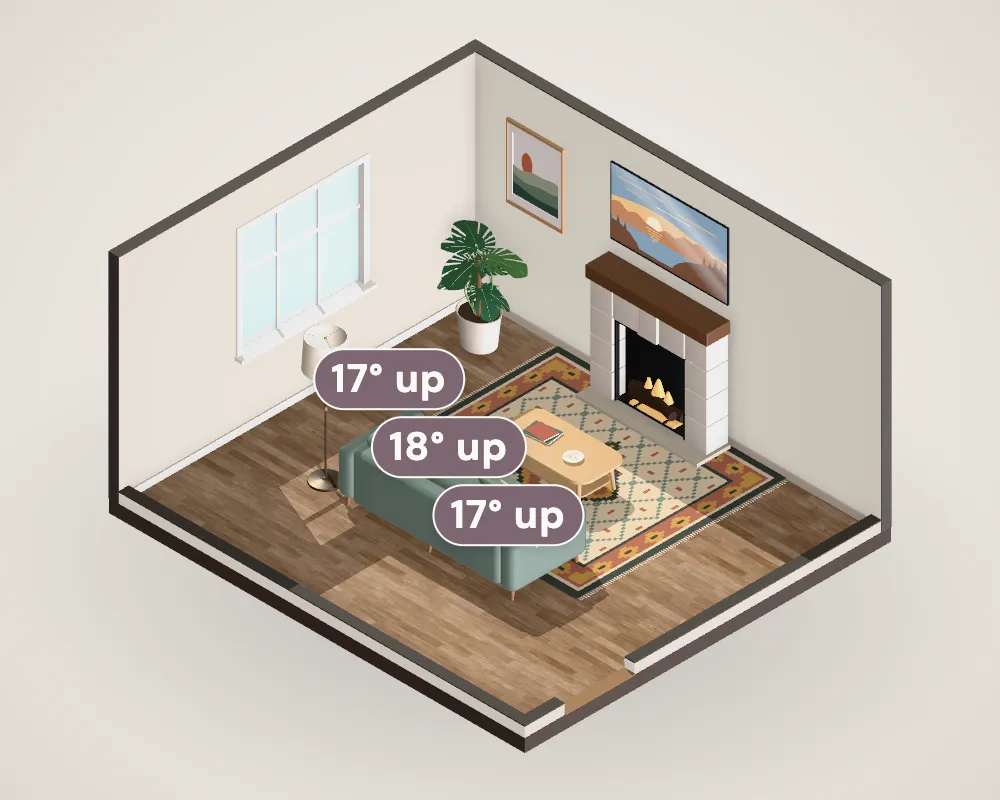
A TV over the fireplace is the most common placement question we see, and it gets the most confident, contradictory answers. The useful way to settle it is to split it into two measurable questions: how far up will you be looking, and how hot will the TV get. A placement can pass one and fail the other.
How far up you’ll be looking
The angle is set by three numbers: the height of the screen’s center, your eye height on the sofa, and how far back you sit. Samsung’s mounting guidance puts the screen’s center near 42 inches, a seated adult’s eye height on a typical couch, so at that height you look straight ahead. Every inch higher tilts your head back.
THX’s viewing guidance keeps the line of sight within 15° of the screen’s center. For comparison, the cinema-design handbook published by UNIC (the international cinema trade body) sets a limit of 25° up to the screen center, but for the front row of a cinema, a seat people choose last. And ergonomic standards for screens point the other way entirely: ANSI/HFES 100 recommends computer screens sit below eye level, and notes that looking up with the head tilted back can be uncomfortable over long periods.
Here is what a 65-inch TV does to the angle from your seat when the bottom of its picture sits 4 inches above the mantel (eye height 42 inches). The 4 inches is our example, not a clearance rule: your fireplace and TV manuals decide the real gap.
| Mantel height | Screen center | From 8 ft | From 10 ft | From 12 ft |
|---|---|---|---|---|
| 48 in | 68 in | 15° | 12° | 10° |
| 50 in | 70 in | 16° | 13° | 11° |
| 54 in | 74 in | 18° | 15° | 13° |
| 60 in | 80 in | 22° | 18° | 15° |
The pattern is simple: sitting further back is what makes a fireplace TV comfortable. Over a 54-inch mantel you need about 10 feet to get within 15°; over a 60-inch mantel, nearly 12. A bigger TV makes it slightly worse, because its center sits higher above the same mantel: a 75-inch over a 54-inch mantel is about 16° from 10 feet, an 85-inch about 17°.

Two things people try that don’t help as much as they hope. Tilting the TV down points the panel at you, which helps picture quality and moves reflections, but your eyes are still looking up at the same spot. And recliners usually lower your eye height a few inches, which makes the angle slightly steeper, not shallower.
Check your own fireplaceEnter your mantel height, TV size and seat distance to see the angle and where the bottom edge lands. Open →How hot the TV will get
TV makers publish an operating temperature range, and that is the number that matters. Here is what the documents we checked say:
| Maker and document | What it says about heat |
|---|---|
| Samsung, mounting support page | Does not recommend mounting above a fireplace; a TV should never get hotter than 104°F (40°C); light a fire and check the temperature first; wood-fire ash can get into the vents |
| LG, 2026 OLED C6 safety manual | Do not install near heat sources; operating range 32–104°F |
| Sony, 2026 BRAVIA 6 safety guide | Do not install near heat sources; operating range 32–104°F |
| TCL, 2026 QM8L quick start guide | No installation near heat sources; operating range 41–95°F |
| Hisense, 2026 U7SG quick setup guide | Operating range 41–95°F |
Note how much lower the TCL and Hisense limits are: 95°F is a warm room in summer before the fire is lit.
What the fireplace does depends on the fireplace. Napoleon’s installation manual for one gas model gives combustible-mantel clearances (a 2-inch-deep mantel at least 12 inches above the opening, up to an 8-inch mantel at 18 inches) and says it tested TV installations, but that these are not a guarantee for every application or TV: temperatures must still meet the TV maker’s limits, and it recommends its heat-management kit. Heat & Glo says a TV can sit 12 inches above some of its units with a passive heat-management system installed. For masonry fireplaces, the International Residential Code limits combustible mantels and trim near the opening; that is a fire-safety rule for the mantel, not a temperature rating for your TV.
We found no published, controlled measurements of temperatures above typical fireplaces, so treat any number you read online without a source with suspicion. The reliable test is your own wall: run the fire for at least an hour and measure the temperature where the TV will hang with a thermometer, at the top edge of where the screen will be.
What actually works
1. Sit further back, and size up to match. If your sofa can sit 10 to 12 feet from a fireplace wall with a mantel around 50–54 inches, a TV above it lands near or within the 15° guideline. This costs nothing and is the most common reason a fireplace TV feels fine to one family and painful to another. The catch is that the picture looks smaller from back there, so this is where a bigger screen earns its keep: from 11 feet, a 75-inch over a 54-inch mantel fills about 28° of your view at about 15° up, where a 65-inch fills only 24°.
2. Mount it as low as the mantel allows. Every inch counts: lowering the center by 4 inches takes about 2° off the angle from 9 feet. Check the fireplace manual’s mantel clearances before you shrink the gap.
3. Use a pull-down mount. A pull-down mount fixes the angle while you watch. The MantelMount MM540, for example, drops the TV up to 27 inches with 9° of tilt and swivels 30° each way, for 44- to 80-inch TVs weighing 20–90 pounds. Its handles change color above 110°F, which is higher than the TV limits above, so an unchanged handle doesn’t prove the TV is safe. MantelMount also advises against leaving the TV lowered while the fire is burning.
4. Put the TV on another wall. Often the right answer in an open living room: the TV goes on the wall the seating faces, and the fireplace becomes a side feature. Room Studio makes this quick to try, because you can drag the sofa and see the angle and the glare from the windows change as you go.
5. Add heat protection where the fireplace maker supports it. A deeper mantel or a manufacturer’s heat-management kit reduces the heat reaching the wall above. Use the kit made for your fireplace, installed the way its manual says.
A quick way to decide
- Read both manuals first. Your TV’s manual may rule out a spot near a heat source outright (Samsung doesn’t recommend above-fireplace mounting at all), and your fireplace’s manual sets the mantel clearances and whether a heat-management kit is required. Those come before any measuring.
- Measure your mantel height and the distance from your eyes on the sofa to the wall.
- Add the gap you’ll leave above the mantel (we use 4 inches in our examples) and half the TV’s picture height (about 16 inches for a 65-inch TV) to get the center height.
- If the center is more than about a quarter of your seating distance above your 42-inch eye height, you’re past 15°.
- With the fire lit for an hour, measure the wall temperature at the TV position. Over your TV’s operating limit is a no. Under it is a good sign, not a guarantee: it’s one reading on one evening.
If the manuals allow it and it passes both checks, a fireplace TV can be a perfectly good choice. If it fails the angle but passes the heat test, a pull-down mount is the fix. If it fails the heat test, move the TV.
Questions people ask
Is it bad to put a TV above a fireplace?
Not automatically, but it fails two common checks. The screen usually ends up well above eye level, past THX’s 15° guideline from typical seats, and fireplaces can heat the TV beyond what manufacturers allow: Samsung says never above 104°F (40°C), and TCL and Hisense rate some current models only to 95°F (35°C). If you sit 10 feet or more away and the wall stays cool with the fire lit, it can work.
How high should a TV be above a fireplace?
As low as the mantel and the heat allow. Each inch you lower it reduces the angle you look up. Over a 54-inch mantel, a 65-inch TV mounted a few inches above the shelf has its center near 74 inches; from 10 feet away that is right at the 15° THX guideline, and from 8 feet it’s about 18°.
How hot is too hot for a TV above a fireplace?
Use the TV maker’s operating limit: 104°F (40°C) for Samsung, LG and Sony examples we checked, and 95°F (35°C) for some current TCL and Hisense models. Measure at the TV’s position after the fire has been burning for a while, not just at start-up.
Does a mantel protect the TV from heat?
It helps. Napoleon’s manual says a mantel reduces the direct heat reaching the wall above, and some gas fireplace makers sell heat-management kits that let a TV sit closer. Neither is a guarantee for every TV; the fireplace manual and the TV’s operating limit both still apply.
Are pull-down fireplace mounts worth it?
They solve the angle problem when you’re watching: a MantelMount MM540, for example, drops the TV up to 27 inches. They don’t solve heat, and the maker discourages leaving the TV lowered with the fire on. On October 4, 2026 it was on sale for $249.95 (list $469.95).
Sources
- Samsung US Support. Where to mount the TV.Manufacturer
- THX. Viewing Guide FAQ.Professional guide
- International Union of Cinemas (UNIC) (2021). UNIC Cinema Technology Handbook (v2).Professional guide
- Human Factors and Ergonomics Society (2007). ANSI/HFES 100-2007 Human Factors Engineering of Computer Workstations (§5.2.4.3).Standard
- LG Electronics (2026). OLED C6 Safety and Reference manual (MFL058141092607REV01).Manufacturer
- Sony Electronics (2026). BRAVIA 6 Safety and Other Information (5-079-179-11).Manufacturer
- TCL (2026). 65–85QM8L Quick Start Guide (US).Manufacturer
- Hisense USA (2026). U7SG Quick Setup Guide.Manufacturer
- Sony Electronics (2025). Television Limited Warranty (4-595-333-04).Manufacturer
- Napoleon (2023). BLP42/46 gas fireplace installation and operation manual (W415-4038/A).Manufacturer
- Heat & Glo. Mounting a TV above your gas fireplace.Manufacturer
- International Code Council (2021). International Residential Code 2021, Chapter 10: chimneys and fireplaces (R1001.11).Standard
- MantelMount. MM540 Enhanced pull-down mount: specifications.Manufacturer
- MantelMount (2024). MantelMount answers your frequently asked questions.Manufacturer
Numbers on this page follow these sources. Where a figure is our own calculation or a rule of thumb, the text says so. Found a mistake? Tell us.