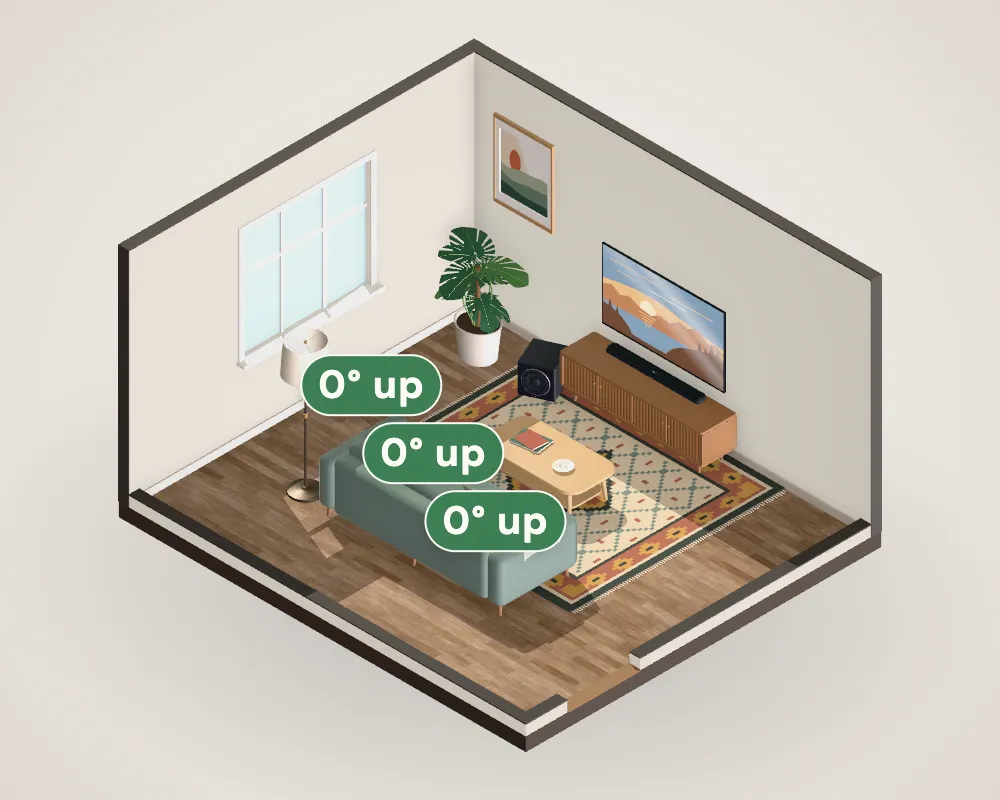
How far should the couch be from the TV?
The right distance depends on the screen, not the room. Here's how to work it out, and how to fit the rest of the furniture around it.
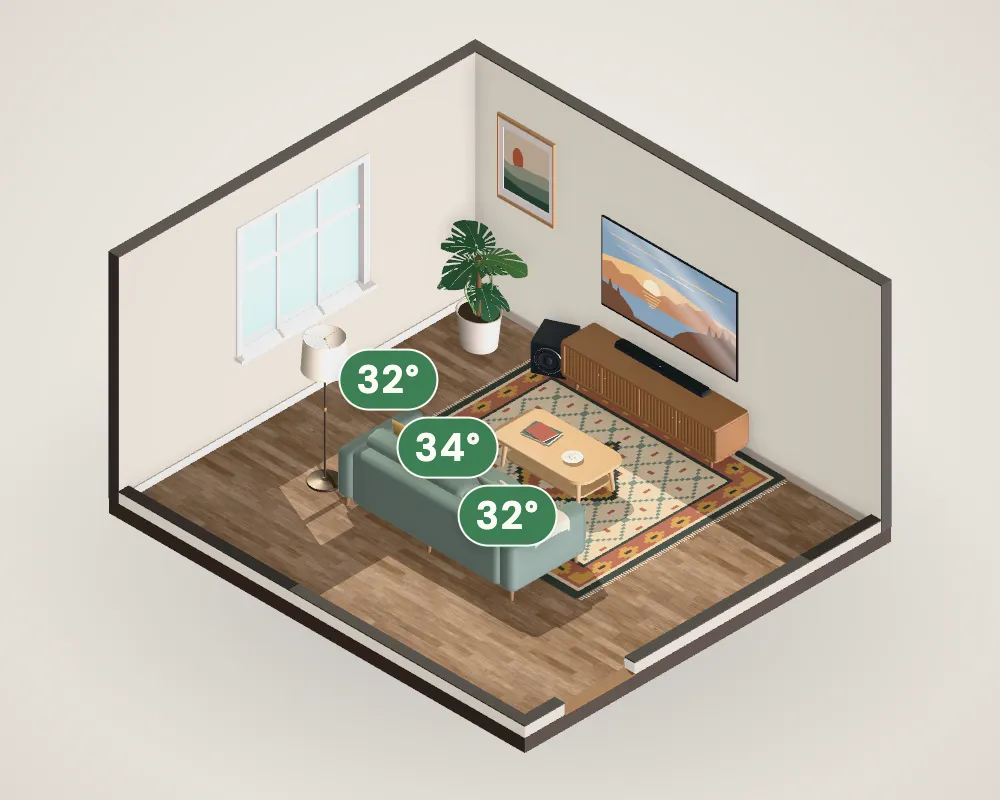
Sit so the screen fills 30–40° of your view, which works out to 1.2 to 1.6 times the TV’s diagonal, measured from your eyes to the screen. That’s about 6.5 to 9 feet for a 65-inch TV, 7.5 to 10 feet for a 75-inch and 5.5 to 7.5 feet for a 55-inch. Further back is fine for casual TV; much closer feels like the front row. Then fit the room around it: keep a walkway of about 36 inches where people pass and roughly 18 inches between the sofa and the coffee table.
Distance is about the viewing angle
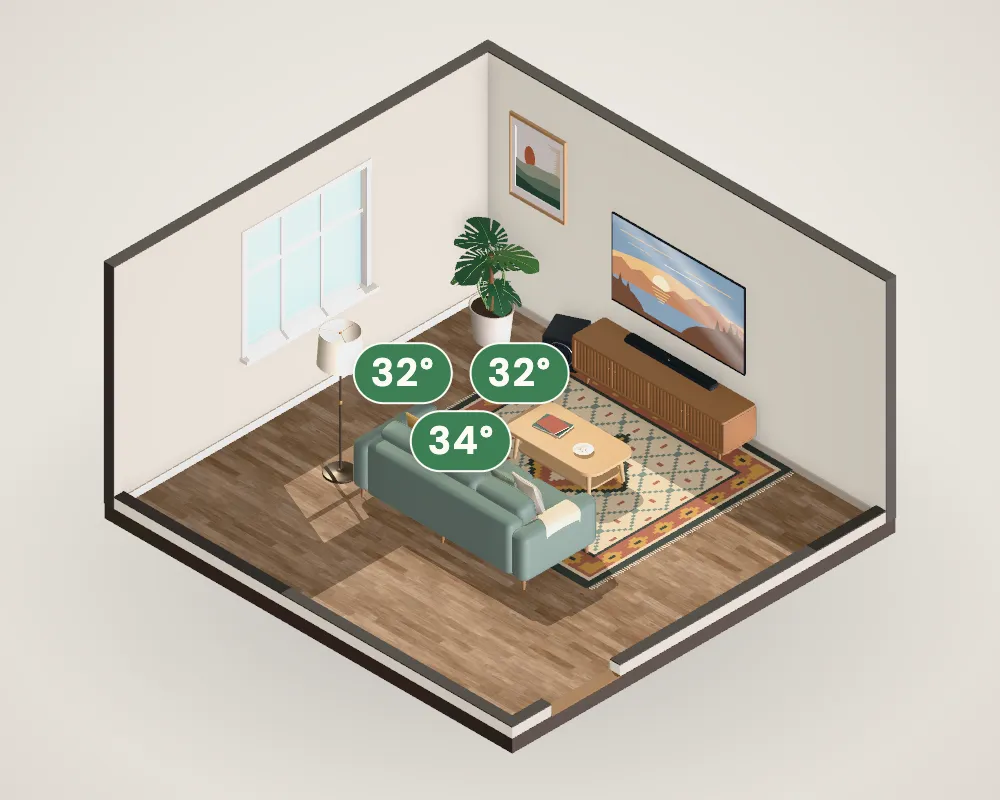
The question people ask is “how far should the couch be?”, but the measurement that matters is how much of your view the picture fills. Two widely used references bracket the sweet spot:
- SMPTE, the standards body for film and TV engineering, sets its reference viewing distance at 3 to 3.2 times the picture height, where a 16:9 screen fills about 31–33° of your view.
- THX recommends a 40° viewing angle for a cinema-like experience, equivalent to sitting at the diagonal divided by 0.835.
Together they give the recommended band of 30–40°, or a distance of 1.2 to 1.6 times the screen’s diagonal. Measure from your eyes, not the sofa: on a typical sofa your eyes are about a foot and a half to two feet in front of the backrest.
| TV size | 40° (THX) | 35° | 30° | Relaxed, about 27° |
|---|---|---|---|---|
| 43 in | 4.3 ft | 5.0 ft | 5.8 ft | 6.5 ft |
| 50 in | 5.0 ft | 5.8 ft | 6.8 ft | 7.6 ft |
| 55 in | 5.5 ft | 6.3 ft | 7.5 ft | 8.3 ft |
| 65 in | 6.5 ft | 7.5 ft | 8.8 ft | 9.8 ft |
| 75 in | 7.5 ft | 8.6 ft | 10.2 ft | 11.3 ft |
| 85 in | 8.5 ft | 9.8 ft | 11.5 ft | 12.9 ft |
| 98 in | 9.8 ft | 11.3 ft | 13.3 ft | 14.8 ft |
The “relaxed” column is Samsung’s rule of thumb (distance equals the diagonal divided by 0.55), which gives about a 27° view: comfortable for everyday TV, a bit small for films. Samsung’s own buying guide elsewhere suggests the diagonal times 1.2, which is almost exactly THX’s 40°. The two numbers aren’t contradictory, they’re different goals.
Working backwards from your room
If the sofa’s position is fixed, flip the table: from your seating distance, these screen sizes fill 30–40° of your view.
| Eyes to screen | Screen size for 30–40° |
|---|---|
| 6 ft | 44–60 in |
| 7 ft | 52–70 in |
| 8 ft | 59–80 in |
| 9 ft | 66–90 in |
| 10 ft | 74–100 in |
| 12 ft | 89–120 in |
Most living rooms end up with the sofa 8 to 10 feet from the TV, which is why 65- and 75-inch screens are the common choices.
TV size & viewing distance calculatorYour distance in, every size's viewing angle out. Open →Closer limits: pixels and comfort
Sitting closer than the band isn’t wrong; it’s more immersive. Two limits apply:
- Pixels. ITU-R BT.1845 designs viewing distances so each pixel spans about one arcminute, roughly the limit of normal vision: 1.6 picture heights for 4K (about 0.8 times the diagonal) and 3.2 for 1080p (about 1.6 times). A 4K screen holds up well even at the THX distance; a 1080p screen looks slightly soft from there.
- Head turning. CEDIA/CTA RP22 cites 61° as the maximum viewing angle for 4K video. Past that you’re turning your head to follow the action: closer than about 0.74 times the diagonal, or 4 feet for a 65-inch TV.
Side seats
Everyone off to the side sees the screen at an angle. The UNIC cinema handbook rates seats within 35° of the screen’s center line as good and up to 45° as acceptable. The TV matters too: RTINGS’ measurements show some VA-panel LCDs losing contrast noticeably at as little as 20° off-center, while OLEDs hold up across wide angles. If a sectional or armchair puts people well off to the side, an OLED or a TV angled toward the seating helps more than any distance rule.
Fitting the rest of the room
Once the sofa’s distance is set, a few clearances decide whether the room works day to day:
- Walkways: about 36 inches. The National Kitchen & Bath Association’s planning guidelines recommend at least 36 inches for walkways, and the ADA uses 36 inches for accessible routes. Neither is a rule for private living rooms, but 36 inches is the practical width people can walk through without turning sideways.
- Coffee table: about 18 inches from the sofa. Pottery Barn’s buying guide suggests about 18 inches between the table and the sofa, with the table about two-thirds the sofa’s length and no higher than the seat cushions.
- The two-thirds rule. Designers often size a sofa at about two-thirds the width of the wall behind it, or of the rug in front of it. It isn’t a requirement: designer Christine Jahan, quoted in Livingetc, calls it “a proportion cue, not a commandment.”
- The TV wall. Leave the area between the coffee table and the TV clear if it’s a through-route, and keep the screen’s center near seated eye height (see how high to mount a TV).
Try it with your own room
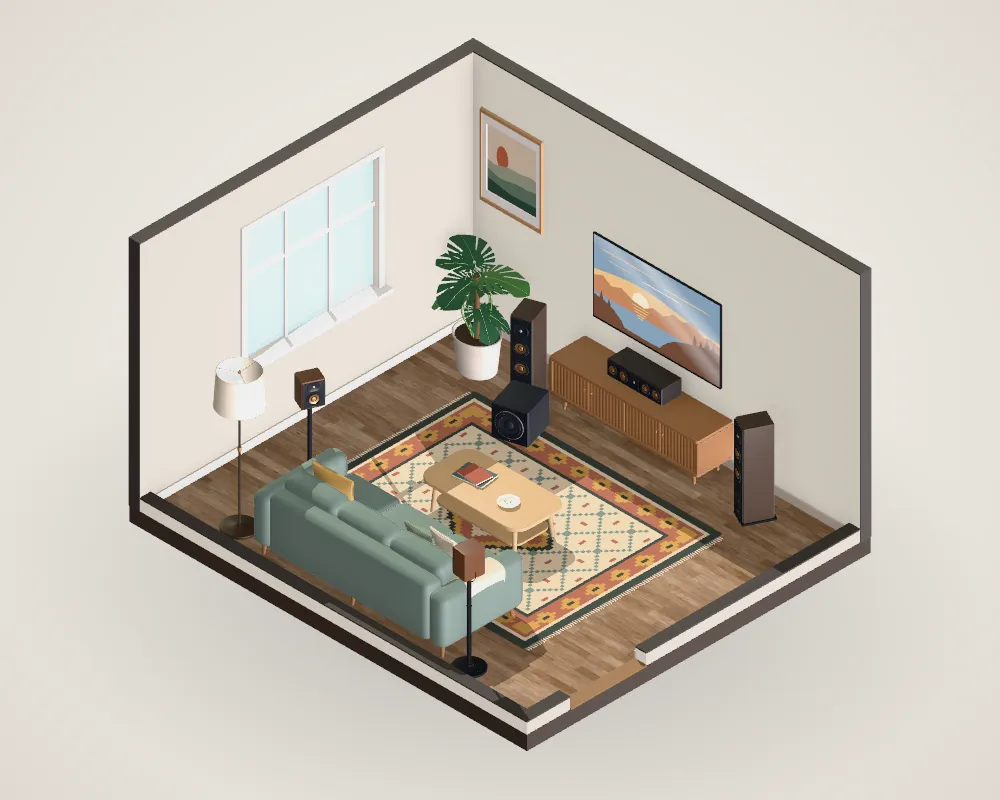
Measuring a room on paper gets you most of the way. The quickest way to be sure is to draw it: open Room Studio, set your room size, drop in your sofa, and turn on the sightlines view. It shows the viewing angle from every seat, flags seats that are too far off to the side, and lets you drag the sofa until the numbers land in the band.
Questions people ask
How far should a couch be from a 65-inch TV?
About 6.5 to 8.8 feet from your eyes to the screen, which puts the back of a typical sofa around 8 to 10.5 feet from the TV wall. At that distance the screen fills 30–40° of your view, the range SMPTE’s reference distance and THX’s cinema guideline span.
How far should a couch be from a 75-inch TV?
About 7.5 to 10 feet from your eyes to the screen. From 9 feet, a 75-inch screen fills about 34° of your view.
Is 10 feet too far to watch TV?
Not if the screen is big enough. From 10 feet you want about a 74- to 100-inch screen to fill 30–40° of your view; a 65-inch fills about 27°, fine for everyday TV but small for films.
What is the minimum distance between a couch and a TV?
There’s no fixed minimum, but past about 61° (closer than about 0.74 times the diagonal) even 4K starts to show pixel structure and you’ll turn your head to follow the action. For a 65-inch TV that’s about 4 feet.
Should a couch be against the wall?
It’s common in small rooms and fine for viewing. For sound, CEDIA/CTA RP22 advises keeping seats off the back wall where possible, because bass builds up there, and to use side surround speakers rather than rear ones if the sofa has to sit against it.
Sources
- SMPTE (2017). ST 2080-3:2017 Reference Viewing Environment for Evaluation of HDTV Images.Standard
- THX. Viewing Guide FAQ.Professional guide
- CEDIA / CTA (2023). CEDIA/CTA-RP22 Immersive Audio Design Recommended Practice, v1.2.Standard
- Samsung US Support. Where to mount the TV.Manufacturer
- Samsung. What size TV should I get?.Manufacturer
- ITU-R (2010). Recommendation ITU-R BT.1845: Guidelines on metrics for image systems including optimal viewing distances.Standard
- International Union of Cinemas (UNIC) (2021). UNIC Cinema Technology Handbook (v2).Professional guide
- RTINGS.com. TV viewing angle test.Measurement
- National Kitchen & Bath Association (2022). Kitchen Planning Guidelines with Access Standards.Professional guide
- US Access Board. Guide to the ADA Accessibility Standards, Chapter 4: Accessible routes (§403.5).Government
- Pottery Barn. The coffee table buying guide.Manufacturer
- Apartment Therapy (2025). My designer friends swear by the two-thirds rule.Rule of thumb
- Livingetc (2025). The two-thirds rule for living rooms.Rule of thumb
Numbers on this page follow these sources. Where a figure is our own calculation or a rule of thumb, the text says so. Found a mistake? Tell us.