Where to put acoustic panels
Panels work best in a few specific places. Here's how to find them in your room, with a mirror or with geometry.
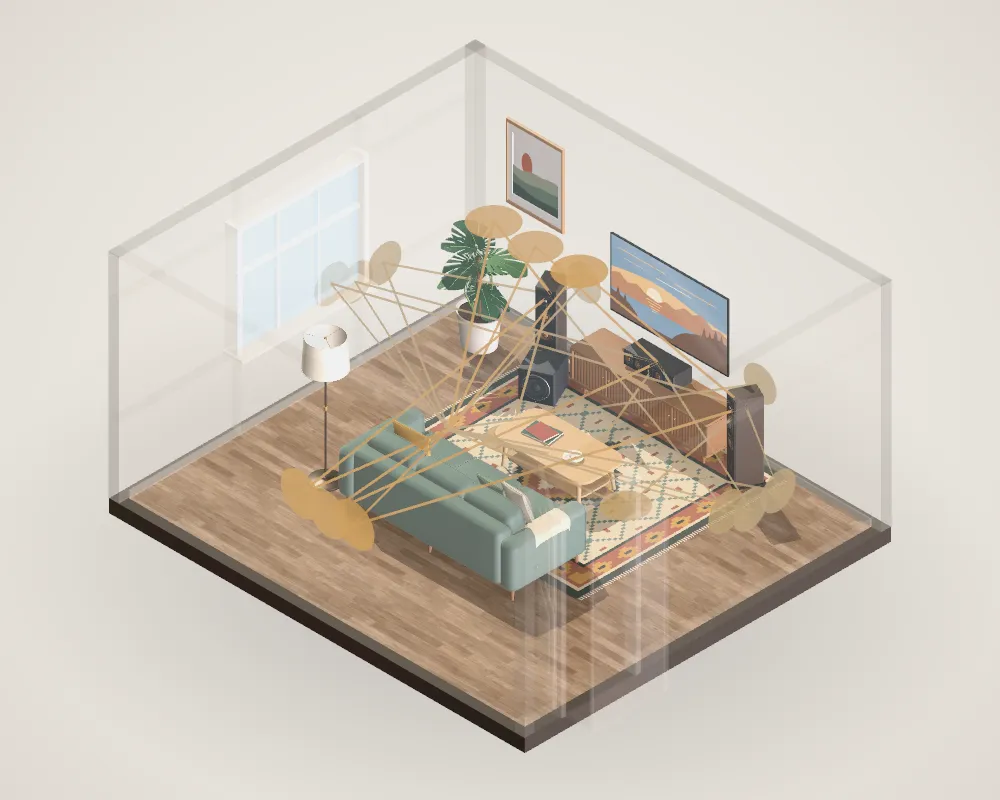
Put the first panels at the first-reflection points on the side walls: the spots where sound from each front speaker bounces once on its way to your seat, at about ear and speaker height. Find them with the mirror trick (sit in your seat while someone slides a mirror along the wall; wherever you see a speaker, that’s a reflection point) or a calculator. Next come the ceiling between the speakers and your seat, the wall behind your seat, and corners for bass traps. Use panels at least 2 inches thick, ideally 4.
Why first reflections come first
Sound from each speaker reaches you directly, and then a few milliseconds later as reflections from the nearest surfaces. The earliest, loudest ones come off the side walls. In a typical living room they arrive only about 3 to 10 ms after the direct sound and only 3 to 7 dB quieter, close enough to blur dialogue and shift where sounds seem to come from.
Listening-room standards target exactly these: ITU-R BS.1116 asks reference rooms to keep reflections in the first 15 ms at least 10 dB below the direct sound, and CEDIA/CTA RP22 sets −8, −10 and −12 dB targets for its higher performance levels.
Not every reflection is bad. Research by Floyd Toole and others found that side-wall reflections can add a pleasant sense of space, especially for music. Treating the first-reflection points is the common middle ground: it sharpens dialogue and imaging without making the room dead.
Finding the spots: the mirror trick
- Sit in your main seat.
- Have someone hold a mirror flat against the side wall at about the height of your ears and the speakers’ tweeters.
- Slide it slowly along the wall from the front.
- Wherever you can see a speaker in the mirror, mark the spot. You’ll usually find two marks on each side wall: one for the near speaker, one for the far one.
- Repeat for the other wall, and for the other seats if several people watch.
Primacoustic’s guidance is to treat the band at ear and speaker height, not the whole wall; with several seats the marks spread into reflection zones.
First-reflection finderThe mirror trick by geometry: enter your room, speakers and seat to get every reflection point. Open →The order of placement
- Side walls, at the first-reflection points for the front left, center and right speakers. A 2 × 4 ft panel centered on each point covers it with margin.
- Ceiling, between the front speakers and the seats. The ceiling reflection is the next earliest. A cloud panel suspended a few inches below the ceiling works well.
- The wall behind the seats, especially if the sofa is close to it.
- Corners, for bass: thick panels or dedicated bass traps across the vertical corners. See bass traps.
- The front wall behind the speakers and TV, particularly if the speakers are within a couple of feet of it.
Thickness and mounting
- 2 inches is GIK’s minimum for speech; 4 inches or more for music and cinema. In ROCKWOOL’s lab test of its ROCKBOARD 60, a 2-inch board absorbed only about a quarter of the sound striking it at 125 Hz and a 4-inch board nearly all of it.
- An air gap behind a panel (mounting it a few inches off the wall) extends its absorption lower in frequency.
- Coverage: Primacoustic suggests 15–25% of the wall area as a starting point for a typical room, 25% or more for a theater; Acoustimac suggests 25–30% of hard surfaces. See how many acoustic panels.
Questions people ask
Where should acoustic panels go first?
At the first-reflection points on the side walls between your front speakers and your listening position. Those reflections arrive earliest and loudest, so treating them makes the clearest difference to dialogue and imaging.
How high should acoustic panels be hung?
Centered around ear and tweeter height for the side-wall reflection points, roughly 3 to 4.5 feet from the floor for a seated listener. Primacoustic notes that you treat the band at that height, not necessarily the whole wall.
Should acoustic panels go behind the TV?
The wall behind the TV and front speakers is a common next step, especially if the speakers sit close to it. The side walls, ceiling and the wall behind the seats usually come first.
Do I need panels on both side walls?
Yes, for symmetry. Each front speaker reflects off both side walls; the nearer reflection is strongest, and treating both walls keeps the left and right sides balanced.
Sources
- Primacoustic (2023). Acoustic panel placement: the mirror trick.Manufacturer
- Primacoustic (2023). How much acoustic treatment do I need?.Manufacturer
- GIK Acoustics (2026). How thick should acoustic panels be?.Manufacturer
- ROCKWOOL. ROCKBOARD 40/60 multi-purpose board — sound absorption data.Measurement
- Journal of the Acoustical Society of America (1979). Image method for efficiently simulating small-room acoustics (Allen & Berkley).Research
- ITU-R (2015). Recommendation ITU-R BS.1116-3: Methods for the subjective assessment of small impairments in audio systems.Standard
- CEDIA / CTA (2023). CEDIA/CTA-RP22 Immersive Audio Design Recommended Practice, v1.2.Standard
- Journal of the Audio Engineering Society / Harman (2006). Loudspeakers and Rooms for Sound Reproduction — A Scientific Review (Toole).Research
- Acoustimac. Acoustic panels, baffles and bass traps FAQ.Manufacturer
Numbers on this page follow these sources. Where a figure is our own calculation or a rule of thumb, the text says so. Found a mistake? Tell us.