Do rugs and curtains help room acoustics?
The cheapest acoustic treatment is often furniture you'd buy anyway. Here's how much it actually does.
Yes, at mid and high frequencies, and almost not at all in the bass. In lab tests, one heavy acoustic curtain absorbed about 72% of sound at 500 Hz hung flat and 89% with full pleats, both hung 150 mm from the wall, while a light curtain absorbed only about 10%. A carpet tile absorbed 47% at 500 Hz but 2% at 125 Hz. So choose heavy, densely woven curtains with about twice their width in fabric, hang them off the glass, and use a thick rug with a pad.
Curtains: weight, fullness and air gap
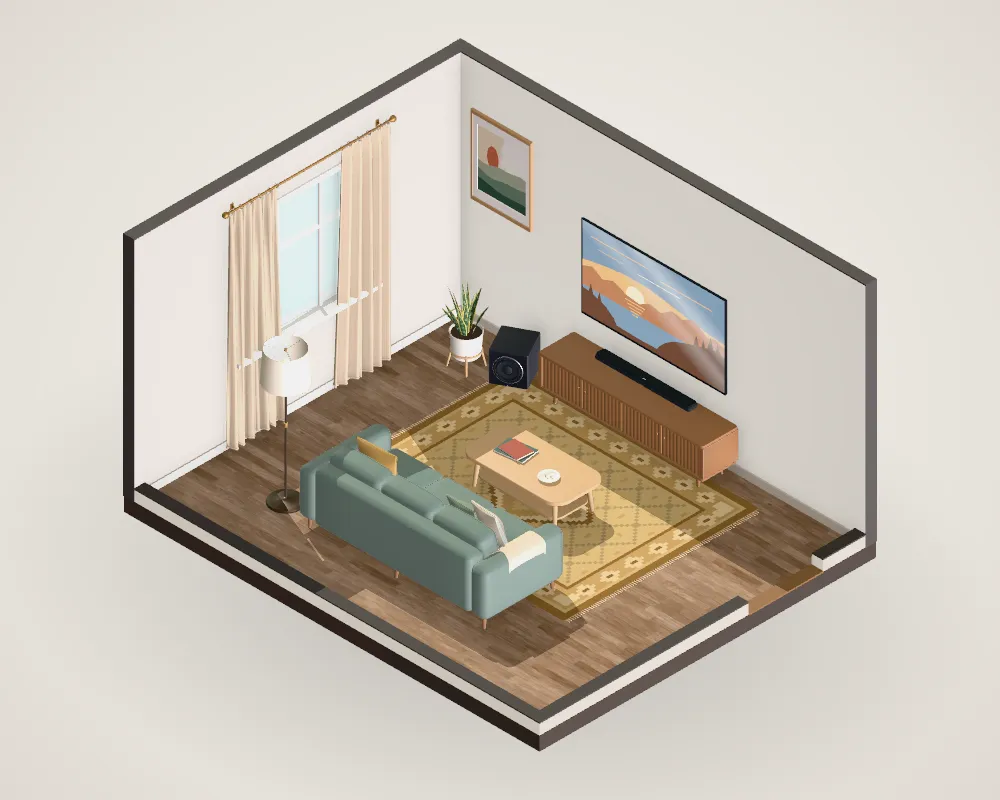
Curtains vary more than any other soft furnishing, and three things decide how much they absorb:
- Fabric weight and weave. Heavier, denser fabric absorbs more.
- Fullness. Gathering twice the curtain’s width in fabric (“100% fullness”) creates deep folds that trap sound.
- Air gap. Hanging the curtain several inches from the wall or window lets it absorb lower frequencies.
Lab tests (ISO 354, reverberation room) show the range:
| Curtain, as tested | 125 Hz | 250 Hz | 500 Hz | 1 kHz | 2 kHz |
|---|---|---|---|---|---|
| Acoustic curtain (MEGACOUSTIC 205 g/m²), flat, 150 mm from wall | 0.01 | 0.20 | 0.72 | 0.67 | 0.72 |
| Same curtain, 100% fullness, 150 mm from wall | 0.02 | 0.36 | 0.89 | 0.87 | 0.92 |
| Light curtain (Polyflax 99 g/m²), 100% fullness, 200 mm from wall | 0.10 | 0.10 | 0.10 | 0.10 | 0.15 |
Absorption coefficients: 1.0 means all the sound striking the curtain is absorbed. Sources: Müller-BBM reports for Création Baumann and Silent Gliss.
The lesson: a heavy, well-pleated curtain can be one of the most effective absorbers in a living room at speech frequencies; a light one barely registers. Neither touches the deep bass. These are specific fabrics tested in a lab, so treat them as the shape of the effect rather than a promise for any curtain: weight, fullness and the gap behind it are what to look for.
Rugs: the floor reflection
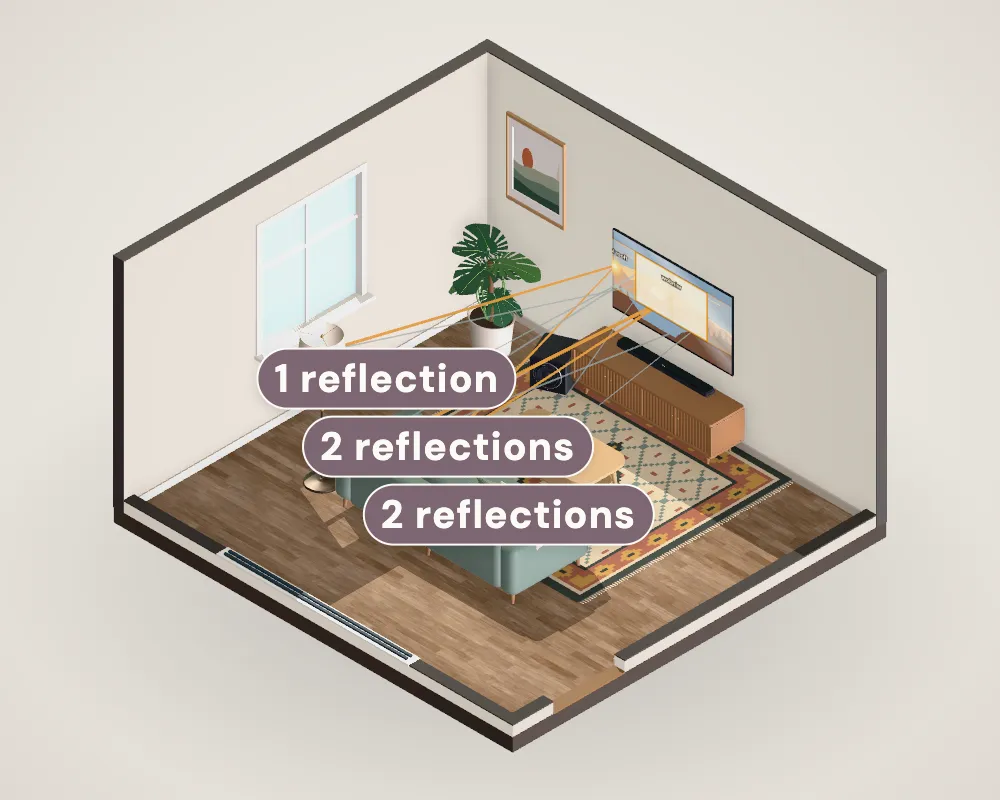
A hard floor reflects sound from the speakers up to your ears, and between floor and ceiling it creates a flutter. A rug breaks that up. There’s little published lab data on ordinary area rugs, but a tested carpet tile shows the shape of the effect: 0.02 at 125 Hz, 0.47 at 500 Hz, 0.31 at 2 kHz. A thick pile rug on a pad will absorb more across the mid range.
Practical points:
- Size: cover the floor between the seating and the screen, where the main floor reflection happens.
- Thickness: thick pile and a dense pad absorb more than a flat-weave.
- Apartments: many leases ask for rugs over hard floors for the neighbors below. One large landlord’s handbook, for example, asks for rugs or carpet over at least 75% of hardwood and tile floors outside kitchens and baths. Rugs reduce footfall noise for the people downstairs; they do little about bass from a subwoofer.
Questions people ask
Do curtains reduce echo?
Heavy curtains do, especially with generous pleats and a gap from the window. In one lab test, the same acoustic curtain absorbed about 72% of sound at 500 Hz hung flat and 89% with twice its width in fabric. Light curtains absorb much less.
Do rugs absorb sound?
They absorb mid and high frequencies and cut the hard floor reflection, which makes a room sound calmer. They do almost nothing for bass. A thick rug with a pad does more than a thin one; we found no published lab test of a typical area rug.
Do blackout curtains help with sound?
We found no lab test of a blackout curtain. In the curtain tests we did find, weight, fullness and a gap from the wall made the difference, so a heavy blackout curtain hung with generous pleats a few inches from the glass should help at speech frequencies. The blackout coating itself isn’t what does it, and no curtain does much for bass.
Sources
- Müller-BBM / Création Baumann (2018). MEGACOUSTIC curtain: sound absorption (Müller-BBM M102794/35).Measurement
- Silent Gliss. Polyflax curtain acoustic test (100% fullness, 20 cm from wall).Measurement
- RMIT / Interface (2015). CushionBac RE carpet tile: sound absorption report (RMIT 15-112).Measurement
- Equity Residential (2020). Resident handbook (noise and floor coverings).Professional guide
- Routledge (2018). Sound Reproduction: The Acoustics and Psychoacoustics of Loudspeakers and Rooms, 3rd ed. (Floyd Toole; ISBN 9781138921368).Research
- CEDIA / CTA (2023). CEDIA/CTA-RP22 Immersive Audio Design Recommended Practice, v1.2.Standard
Numbers on this page follow these sources. Where a figure is our own calculation or a rule of thumb, the text says so. Found a mistake? Tell us.